"All the World's a Stage We Pass Through" R. Ayana

Showing posts with label david hudson. Show all posts

Thursday, 21 October 2010

ORMUS: The Quest for the Philosopher’s Stone

ORMUS: The Quest for the Philosopher’s Stone

http://www.spiritofmaat.com/archive/dec3_carter_ttl.jpg


In the late 1970s an Arizona farmer named David Hudson noticed some very strange materials as he was doing some gold mining on his land.  Hudson spent several million dollars over the following decade figuring out how to obtain and work with these strange materials.  

In 1989 David Hudson was granted patents on these materials and methods for obtaining them.  Two of these patents can be found on the World Wide Web at:

DID HUDSON FIND thePHILOSOPHER'S STONE?


Since ancient Egyptian times, alchemists have worked in secret to produce something called the Philosopher's Stone, or the Elixir of Life.  The materials that Hudson and other researchers have found are believed to be related to the Philosopher's Stone.  The materials have been called ORMEs, monoatomic gold, white gold, white powder gold, ORMUS, m-state, AuM, microclusters, and manna.  

David Hudson calls the materials he found Orbitally Rearranged Monoatomic Elements or ORMEs.  He also refers to them as monoatomic elements in a high-spin state. 

Since Hudson has patented his process for obtaining and identifying these elements, we would like to suggest that the terms ORMUS and m-state be used when referring to this state of matter. 

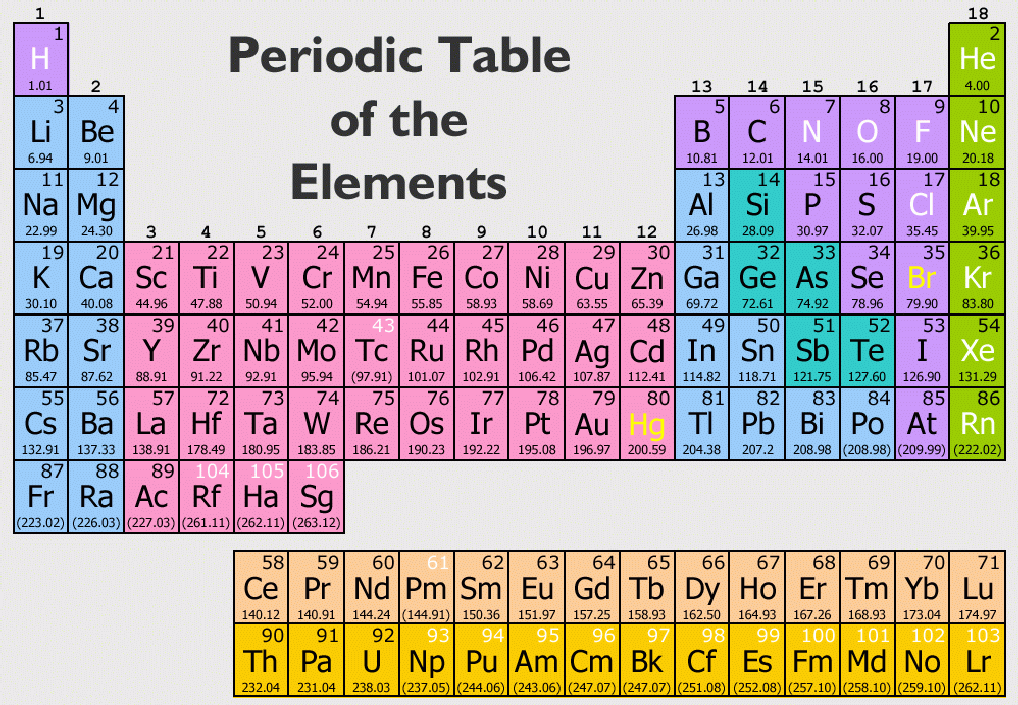
The ORMUS or m-state materials are thought to be the precious metal elements in a different atomic state.  The following elements have been identified in this different state of matter (these elements, with the exception of mercury, are listed in Hudson's patents): 


KNOWN ORMUS ELEMENTS
Element
Atomic Number
Cobalt
27
Nickel
28
Copper
29
Ruthenium
44
Rhodium
45
Palladium
46
Silver
47
Osmium
76
Iridium
77
Platinum
78
Gold
79
Mercury
80


All of these m-state elements are abundant in sea water.  According to David Hudson's discoveries, these elements in their m-state may be as much as 10,000 times more abundant than their metallic counterparts.  There also may be other elements which occur naturally in the m-state. 

Various researchers, working independently, have identified these materials in this different state of matter.  They have arrived at many of the same observations.
These m-state elements have been observed to exhibit superconductivity, superfluidity, Josephson tunneling and magnetic levitation.  It looks like these are an entirely new class of materials. 

These m-state elements are also present in many biological systems. They may enhance energy flow in the microtubules inside every living cell. 

It appears that this state of certain of these elements has been known throughout history.  Several of the procedures for extracting or making ORMUS have been adapted from ancient alchemical texts.  We believe that the Philosopher's Stone and the Biblical manna are both variations on this state of matter. 

Some recommended alchemical texts related to the Philosopher's Stone are "Sacred Science" by R.A. Schwaller De Lubicz and "Le Mystere des Cathedrales" by Fulcanelli, available from Amazon.com. Another source is "Occult Chemistry" by Leadbeater and Besant. The premier treatise on the subject may be "The Secret Book" by Artephius which is available at these Web sites:

There may be several paths to the Philosopher's Stone.  There may even be several different Stones.  More research on the nature of m-state is needed.  Since the ORMUS materials are much more prevalent in nature than their metallic counterparts, they can be extracted with some time, effort, and understanding.  We invite others to join in the quest for knowledge of these materials.  

THEORIES from PHYSICS and CHEMISTRY ABOUT the M-STATE ELEMENTS


The following information is presented to promote scientific research into the nature of these materials. Although these theories are based on our best knowledge at this time, further scientific research may prove some of these theories to be inaccurate.  Remember that the following are just theories.  

A monoatomic element has one atom per molecule; a diatomic element has two atoms per molecule. Certain elements in a monatomic or diatomic configuration can form a stable structure where all of their electrons are Cooper paired, and so are not available as valence electrons (more on this later).  Elements in this configuration are superconductors at room temperature and exhibit other quantum physical behaviors at a visible scale.  Some of these quantum physical behaviors include:
  • Anomalous responses to gravity
  • Superfluidity
  • "Tunneling" through solid objects
  • Deformed nuclei in a high-spin state

One term for these materials is microclusters.  Microclusters have been described as follows on a microcluster forum

"A microcluster is a small chemically inert cluster of atoms that has definite crystalline structure. They can be synthetic, however for this work an assumption is that the natural microclusters are forms comparable to the man-made microcluster. Microcluster research started with natural occurrences. Clusters exist as molecular species which can substitute and mimic various elements for one another. Microclusters can be as large as 200 or more atoms. Certain atomic examples for each atom are rare; the rarity is due to current physical chemistry concepts.

Research has demonstrated that natural micro-clusters are superconductors; they are Cheshire in that they can disappear and avoid chemical detection by conventional means. Most, if not all, have catalytic properties; they are magnetic or can be induced to have electromagnetic properties; and they can form giant inert ions which I call Mega-ions."

ORMUS and BECs


Physicists have recently created a new state of matter (which we believe is related to ORMUS) in the laboratory. This state of matter is called a Bose-Einstein Condensate (BEC) after Satyendra Nath Bose and Albert Einstein who postulated the existence of this state of matter in the 1920s. Their theory was not "proven" until BECs were created in the laboratory in 1995 by Eric Cornell and Carl Wieman in Boulder, Colorado. They did it by cooling atoms to a much lower temperature than had been previously achieved. This temperature was a millionth of a degree above absolute zero.  

Absolute zero is the temperature at which all atomic movement ceases. When atoms are cooled near absolute zero, they move much more slowly than when they are at normal temperatures. David Hudson postulates that his ORME atoms have a natural internal temperature which is very close to absolute zero. This may be why they can be Bose-Einstein condensates at room temperature and higher. 

A Bose-Einstein Condensate is a group of atoms which are all in the same quantum state. Such a group of atoms consequently behaves, in some ways, as a single atom. Superconductors are a form of BECs and so are superfluids.
You can read a simple description of what BECs are and how they work on the BEC homepage.
 
Here is an explanation of how BECs, superconductors and Cooper pairing inter-relate from the American Institute of Physics web page titled BECs, superconductors, and Cooper pairing:
 
"A superfluid is a liquid that flows without viscosity or inner friction. For a liquid to become superfluid, the atoms or molecules making up the liquid must be cooled or "condensed" to the point at which they all occupy the same quantum state. A liquid of helium-3, an atom whose nucleus is made up of an odd number of particles, is a type of particle known as a fermion. Groups of fermions are not allowed to occupy the same quantum state."  

"By cooling the liquid to a low enough temperature, helium-3 atoms can pair up. The number of particles in each nucleus adds up to an even number, making it a type of particle known as a boson. Groups of bosons can fall into the same quantum state, and therefore superfluidity can be achieved. 

Helium-4 (middle panel), a boson, does not need to pair up to form a superfluid; groups of helium-4 atoms condense into the superfluid state at about 2 degrees above absolute zero. Superfluidity, especially the kind that exists in helium-3, is analogous to conventional low-temperature superconductivity, in which electrons flow through certain metals and alloys without resistance. In a superconductor (right panel), electrons, which are fermions, pair up in the metal crystal to form "Cooper pairs," bosons which can then condense into a superconducting state." 

 http://www.bibliotecapleyades.net/imagenes_ciencia/oro21_03.jpg


The DIATOMIC NATURE of SOME M-STATE MATERIALS


The following elements, which are known to have an m-state, have an odd number of electrons and protons:  

Cobalt
Copper
Rhodium
Silver
Iridium
Gold

In order for these atoms to be superconductors in the m-state, they must be at least diatoms.  

The m-state of gold and other precious elements is different from the metallic state of these same elements. For example ingesting m-state gold has different effects on the body than the effects of ingesting metallic gold. What makes the ORMUS state atoms different is that they will not form metal-metal bonds with their own kind. 

They won't form metal-metal bonds because their valence electrons are not available to form normal molecular bonds. This is because each electron is paired up with another electron in a Cooper paired state. When electrons are Cooper paired, they cease to behave as particles and begin to behave more like light. 

Since you must have an even number of electrons in order for every electron to pair up with another electron, you cannot have the m-state of any element which has an odd number of electrons without having at least two of these atoms paired up. 

For example, iridium has an atomic number of 77. This means that iridium has 77 electrons. 76 of these electrons could pair up but that would still leave one electron available for bonding with another atom in a compound. But if you had two atoms of iridium with mingled nuclei and electron clouds you would have 154 electrons. 

Since 154 is an even number, all of these electrons can pair up into 77 Cooper pairs. Nucleons also pair up in the same way to form superconductors.
All known superconductors involve this kind of Cooper pairing. 

Please realize that as a Bose-Einstein condensate, both atoms in the diatom will behave as one atom. They also resonance couple with other diatoms of the same element which are nearby. This resonance-coupled quantum oscillation is another of the definitions of superconductivity. 

As you use chemistry to move a metal toward the ORMUS/BEC state, the chemical reactions necessary to do this moving become weaker and weaker since fewer and fewer of the valence electrons are available to participate in the chemical reactions. Eventually there are no electron handles that can be used to manipulate these materials. Fortunately these materials have other properties which can be used to manipulate them. 

Since they are superconductors, they can be manipulated by magnetic fields. For example, if you shield them from magnetic fields during boiling processes, you will be able to conserve more of them in your liquid since they will not be impelled to tunnel out of your container or go off as a gas. 

They can also be manipulated by providing them with a comfy "box" to hide out in. The ORMUS/BECs seem to "like" tight spaces. Ring molecules such as the tri-sodium ring or the diozone ring can provide a chemical "box" with handles. Salt and sodium, in particular, seem to stabilize the ORMUS materials, theoretically by forming a triangular structure or box around the precious element atom. Though you cannot get a chemical handle on the fully Cooper paired ORMUS atoms, you can entice them into a chemical box with handles and then manipulate the box using fairly standard physical and chemical methods. 

So, although these elements are the same as the "heavy metal" elements, they are not in a metallic state and as long as the m-state of these elements is present in sufficient amounts, the metallic portion seems to "borrow" the properties of the m-state. 

BECs are also known to have the ability to "tunnel" across impenetrable barriers. Professor Brian D. Josephson of the Theory of Condensed Matter Group of the Cavendish Laboratory, Cambridge (i.e. the Physics Department of the University of Cambridge) received the Nobel Prize in physics for his discovery of the tunneling phenomenon. Dr. Josephson is currently working on something called the Mind-Matter Unification Project.


ORMUS and MICROTUBULES


Other physicists are also working on theories which unite mind and matter.  

One fairly recent discovery in biology and physics is that a certain small structure in every cell, called the microtubule, exhibits superconductive and tunneling behaviors at body temperature. 

You can read more about the quantum properties of microtubules from links on Rhett Savage's Quantum Brain web page.

And on several of Matti Pitkanen's web pages:

One of the problems with modern quantum physical theories is that there is no way to logically connect the Bose-Einstein condensates, which have been demonstrated to exist in small groups of atoms at a millionth of a degree above absolute zero, with the BEC like behavior of microtubules at body temperature in  living cells. ORMUS materials would make this connection.  

Several of the modern theories relating to microtubules were proposed by Roger Penrose (a physicist) and Stuart Hameroff (an anesthesiologist). 

Here we will quote from an anonymous scientist who has explained Penrose and Hameroff's theory quite elegantly: 

"Penrose has been seeking a better way to explain the fantastic computational power of the brain and Hameroff has been seeking the source of consciousness. The two heard of each other and got together to find that they both sought a common structure, the microtubule. 
"Penrose sought a structure in the brain that had nanometer dimensions because such a structure would be necessary to support quantum effects. Hameroff sought the structure responsible for consciousness. They agreed that the microtubules would provide for both.  

"Mictotubules are tiny tubular structures within neurons that are made from two forms of tubulin. The two forms can be switched by tiny electric currents, so Penrose has proposed that the tubulin units may be the on/off switches for the brain's data processing. I agree with this proposal because it allows us to be what we are by increasing our potential processing rate from from an unacceptable 10 Exp11 operations per second (OPS) to a reasonably acceptable 10 Exp24 OPS. Penrose explains all this quite well and I recommend him to all who would like to have a deeper understanding of our minds.  

"Hameroff has done a lot of research into how consciousness works and he has concluded that the microtubules are the source of our consciousness. This is discussed in and supported by Penrose’s work. Hameroff has concluded that the observable quantum effects that occur in human brains are caused by highly aligned water that is inside the microtubules. Penrose agrees with this concept and further argues that Bose- Einstein Condensations (BECs) in the neurons are how we reach decisions. The BECs are possible because the water inside the microtubules can be strongly aligned to form a high-temperature superconductive medium. 
"This concept supports my thinking very well. BECs provide an explanation for all the effects I refer to as psionics. These effects include: telepathy, remote viewing, bilocation, telekinesis, and astral travel. A BEC in the Broca area of the brain would allow thoughts to exist inside the brain and outside the head at the same time. This can explain both telepathy and how it is controlled. Likewise, a BEC in the visual processing areas would explain remote viewing. Since microtubules exist in all neurons and neurons extend into all parts of the body, a BEC including all neurons would allow the body to exist in two (or more) places at the same time, thus explaining bilocation.  

"With this discovery, all psionics can be explained in modern physical terms. This opens the whole field of psionics to persons like myself who have had so much technical training that it is impossible to accept psionics. This discovery means that all the formal training I've had in Chemistry, Math, and Physics still applies and can even help explain psionics. For me, it is good to know that all these topics can exist peacefully together." 

For more information on "psychic" observations of these materials see:


In a paper titled "Orchestrated reduction of quantum coherence in brain microtubules: A model for consciousness" (Hameroff/Penrose site at U. of Arizona), Hameroff and Penrose write:  

"A critical number of tubulins maintaining coherence within [microtubules] for 500 msec collapses its own wave function (objective reduction: OR). This occurs because the mass-energy difference among the superpositioned states of coherent tubulins critically perturbs space-time geometry. To prevent multiple universes, the system must reduce to a single space-time by choosing eigenstates." 

Hameroff and Penrose are saying that in order to avoid "seeing" multiple universes at the same time, the quantum coherence created in microtubules by some material (we think the m-state materials) must collapse. What if the quantum coherence did not collapse and we became aware of multiple universes?  

Many modern physicists believe that there are an infinite number of parallel universes. They theorize that atoms are made up of smaller particles which are like bubbles in the quantum foam. These bubbles in the quantum foam or "holes in the aether" spend a fraction of their existence in each of these parallel universes. There is quite a debate as to whether information is transferred between these parallel universes. You can read a bit about this debate at: 

This concept of multiple or parallel universes has been a recurring theme in science fiction for at least 60 years.  It is also one of the key concepts of modern mystical thought.  It first appeared as a mystical concept in The 'Unknown' Reality by Jane Roberts which was dictated by Seth in 1974-75.  

SOME TESTS for M-STATE


M-state material, in a wet precipitate form, will dissolve in HCl. M-state material, in a dry powder form, will not dissolve in HCl or aqua regia.
Because m-state is a superconductor, rotating a magnet under some of the dry powder m-state elements will cause the powder to fly away from the magnet. 

INFORMATION RESOURCES


For the interested person willing to do the necessary work, there is an abundance of detailed technical information available on the Web.  The best related web sites are:
During the early 1990s Hudson toured the United States giving lectures and workshops about what he had found.  Transcripts of portions of three of David Hudson's lectures are available on the Web. The most complete of these transcripts is the transcript of his Dallas lecture and workshop.  You can find this transcript on the Web at:
The two other Hudson transcripts can be found at:
http://elaine.teleport.com/~boydroid/gold.htm
Hudson's Virginia Beach Lecture

Images – http://www.spiritofmaat.com/archive/dec3_carter_ttl.jpg
http://www.lifetechnology.org/images/ormus2.gif
http://www.bibliotecapleyades.net/imagenes_ciencia/oro21_03.jpg


For more information about ORMUS see http://nexusilluminati.blogspot.com/search/label/ormus
- Scroll down through ‘Older Posts’ at the end of each section


Do you LIKE this uniquely informative site?
Hours of effort by a genuinely incapacitated invalid are required every day to maintain, write, edit, research, illustrate, moderate and publish this website from a tiny cabin in a remote forest.
Now that most people use ad blockers and view these posts on phones and other mobile devices, sites like this earn an ever shrinking pittance from advertising sponsorship. 
This site needs your help.
Like what you see? Please give anything you can -  
Contribute any amount and receive at least one New Illuminati eBook!
(You can use a card securely if you don’t use Paypal)
Please click below -


And it costs nothing to share this post on Social Media!
Dare to care and share - YOU are our only advertisement!


For further enlightening information enter a word or phrase into the random synchronistic search box @ the top left of http://nexusilluminati.blogspot.com


And see


 New Illuminati on Facebook - https://www.facebook.com/the.new.illuminati

New Illuminati Youtube Channel -  https://www.youtube.com/user/newilluminati/playlists

New Illuminati’s OWN Youtube Videos -  
New Illuminati on Google+ @ For New Illuminati posts - https://plus.google.com/u/0/+RamAyana0/posts

New Illuminati on Twitter @ www.twitter.com/new_illuminati


New Illuminations –Art(icles) by R. Ayana @ http://newilluminations.blogspot.com

The Her(m)etic Hermit - http://hermetic.blog.com


DISGRUNTLED SITE ADMINS PLEASE NOTE –
We provide a live link to your original material on your site (and links via social networking services) - which raises your ranking on search engines and helps spread your info further!

This site is published under Creative Commons (Attribution) CopyRIGHT (unless an individual article or other item is declared otherwise by the copyright holder). Reproduction for non-profit use is permitted & encouraged - if you give attribution to the work & author and include all links in the original (along with this or a similar notice).

Feel free to make non-commercial hard (printed) or software copies or mirror sites - you never know how long something will stay glued to the web – but remember attribution!

If you like what you see, please send a donation (no amount is too small or too large) or leave a comment – and thanks for reading this far…

Live long and prosper! Together we can create the best of all possible worlds…


From the New Illuminati – http://nexusilluminati.blogspot.com

Thursday, 15 July 2010

Superconductivity and Modern Alchemy: Has the Philosopher's Stone Been Found? – Part 5

ORMES - Orbitally Rearranged Monatomic Elements

Superconductivity and Modern Alchemy


 http://larvalsubjects.files.wordpress.com/2009/11/periodictable.gif


Has the Philosopher's Stone Been Found? – Part 5


Elemental Workshop with David Hudson

 Introduction by Cheyenne Turner:I want to welcome you to Eclectic Viewpoint and a workshop with David Hudson. David is an Arizona farmer who has made some remarkable discoveries. He's filed patents on 11 different forms of elements that were not known to exist before, and he started this by getting involved with extracting gold and silver from the tailings from gold mines. [He found a] powdery substance that was interfering with his extraction process, and this started him on a whole new adventure - which led him into alchemy and lots of other fascinating things... 


We were talking about the mysterious white powder that we had developed. This is not just gold - there are actually 11 elements that were in our patents. Since that time we found one more, so there's a total of 12 elements that can exist in this white powder state; one of them happens to be gold. We have 2,000 ounces of rhodium and iridium per ton, we have about 12-13 ounces of gold, so in processing this material I got a lot of rhodium and iridium; I have very small amounts of gold. So our work tends to be with rhodium and iridium.

   We're going to be presenting the Scientific American articles and the published papers in Physical Review predominantly, which show the discovery of this form of matter. Now when a man stands up here, particularly a cotton farmer, and tells you he's got patents on this new form of matter, you're going to be just like the U.S. patent office. When I filed for a patent on gold, they said, "What? You mean gold oxide or gold chloride or a gold compound?", and I said, "No. This is gold. Elemental gold". And they said, "Well, that's not patentable. Everyone knows about gold". And I said, "No, they don't know about this form of gold". And of course that's quite a hurdle. And they say, "What are your credentials?" Well, "I'm a cotton farmer". Ah-hah. “Oh, now I see what the problem is. You go back and plant the fields and let us handle the high technology materials.”

   This is an article on micro clusters from Scientific American, December 1989 [p. 110 - Microclusters by Michael A. Duncan and Dennis H. RouvrayI It describes very accurately the aspects that we're dealing with.   "Divide and subdivide a solid and the traits of its solidity fade away one by one, like the features of the Cheshire Cat, to be replaced by characteristics that are not those of liquids or gases. They belong instead to a new phase of matter, the micro cluster. Micro clusters consist of tiny aggregates comprising from two…" (key word "two", because it's clusters) "to several hundred atoms. They pose questions that lie at the heart of solid state physics and chemistry, and the related field of material science.

   “How small must an aggregate of particles become before the character of the substance they once formed is lost? How might the atoms reconfigure themselves if freed from the influence of the matter that surrounds them? If the substance is a metal, how small must this cluster of atoms be to avoid the characteristic sharing of free electrons that underlies conductivity?"

   That’s the introduction for the subject that I am dealing with. And what we found is that every element has a minimum cluster size where it has metallic character, and once the cluster goes beyond or below that critical minimum size, it breaks up totally on its own. And every element is different.

   For example; for iridium, it's a 9 atom cluster, for platinum it's a 5 atom cluster, for palladium it's a 7 atom cluster, for gold it's a 2 atom cluster. Anything larger than that stays metallic, and will aggregate and become more metallic. Anything less than that will literally break up on its own; it literally comes apart on its own.

   This makes for a very interesting situation. If you send platinum or iridium to Englehard or Johnson Matthey - which are the two big precious metal refineries in London - they will guarantee you a 99.9% recovery on gold. If you send them platinum they will guarantee you about 98 and a half percent recovery, but if you send them iridium they will not guarantee you over an 86% recovery. Now most precious metal people believe that they're being cheated out of their precious metal, that the refinery is keeping that precious metal.      That's not true; they actually lose it in the processing, because iridium isn't stable below 9 atom clusters. In the dissolution of the iridium, about 14% actually gets below 9 atom clusters and will not recover as metal compounds - and so it's “lost in the system”. This is why, and the precious metal community is not aware of this. They know they have loses, but they don't understand why - and this is why.   

http://tesla3.com/free_websites/ormus_geant_oranges.jpg

An article from Scientific American, March 1990 [pp. 58-67, New Radioactivities by Walter Greiner and Aurel Sandulescu], describes new radioactivities. The example they give is Uranium 232. Now this happens to be a radioactive isotope, but don't let that fool you; this is a phenomenon that relates to all elements. On the first page, Uranium 232 is actually is showing the proton and neutron orbitals; the alternating black and white orbits are, in fact, the nuclear orbitals.


 Now, most of us have never heard about nuclear orbitals, we've heard about electron orbitals; you remember back in chemistry class you had 2, 8, 8, 16, 32? These are the sequences that the electron orbitals fill.   Well the nucleus fills the same way; the proton and neutron orbitals actually fill in harmonic sequences. These big heavy nuclei are called the actinide group; the elements that begin with Actinium, the heavy ones at the bottom of the Periodic Table of Elements.  Actinium is 89. The Periodic Table then goes from 90 all the way up to 103, and then we go to 104 and 105 - so they're actually out of sequence here; this is called the Actinide group, which are the heavy elements.

 Around 1985-86 nuclear physicists were watching Actinide group elements, and all of a sudden an atom blew apart - it literally came apart all on its own. There were no gamma emissions, there were no alpha emissions, there was no beta emissions. There was heat emission - tremendous heat - but one element became two elements; bang, it just happened.   It really took the physicists aback, because this was not an element that they expected to come apart - this was a stable element. As they begin to investigate it, they found out that all of the Actinide group would do this.

 These are heavy nuclei - they're big and fat, with lots of protons and lots of neutrons - and they said, "Well maybe it's just because they're big cumbersome nuclei; they're not that stable anyway". But within a couple of years, these same researchers began to find that the rare earths would do this, the Lanthanide group.   (For those of you who aren't chemists, element number 57 is lanthanum, and all the elements near it are called the Lanthanide group, or the rare earth group. They have a place by themselves on the Periodic Table, because you're supposedly not going to run into them that often in the normal chemistry you're performing - and so like the Actinides, they stick them at the bottom of the Periodic Table). They found that Samarium through Dysprosium would do the very same thing; a single atom could come apart all on its own, and they're not radioactive isotopes.

   Now this is very serious stuff, because we've been taught that the nucleus is a very stable thing, and that it takes tremendous energies to blow it apart. It takes energies up about one million electron-volts to knock a nucleus apart - and yet they found that Samarium through Dysprosium would do this; Samarium, Europium, Gadolinium, Terbium, and Dysprosium would all do this.   What they learned is that the nucleus is a very snobbish thing.

 As the electron orbitals fill, so do the nuclear orbitals, and the elements that are half-filled or half-empty - the ones in the middle of the Periodic Table, keeping in mind that Samarium through Dysprosium are in the middle of the rare earths – these harmonically complete filled orbitals actually say "You unfilled orbitals get out of here. You can't be next to us filled orbitals - you get away from here and come back when you're filled, and then you can be part of us - but in the meantime get the heck out of here".


   So those partially filled orbitals are excluded away from the filled orbitals; this is inherent in a monatomic system. This will not happen if you have diatomic systems or larger, and this phenomena in physics is called dipole-dipole connection between nuclei, where the nuclei actually interact with each other. It's kind of like a two cylinder motor; in a two cylinder motor the pistons run opposite each other, and so even thought there's a vibration, they compensate and neutralize each other - and so the motor is pretty still. But when you take one cylinder away and you have a one cylinder motor, there’s an inherent vibration - you can't help it.

   So there's one little naked atom who has got this out of balanced phenomenon in the nucleus, and it's spinning – it’s literally like a tire with a knot on it; klunk-klunk-klunk - and it excludes these unfilled orbitals. These protons and neutrons that are not filled get pushed away from it, and it creates a figure eight or coke bottle shaped nucleus.

   This is new stuff - you're not going to find it in universities, you're not going to be taught it, because it's new; it was just 1985-86 when it was first discovered. It's in the published literature. Probably 50-60% of the physics papers in Physical Review C are related to this area right now - it is a hot topic - but very few college professors ever heard of it because it wasn't in their curriculum when they studied. It's not in the books yet either.

  Reading from the article, "It is now known that the atomic nucleus is a more or less spherical object, whose diameter is about a few fermis, a unit of measure equal to one quadrillionth of a meter, or simply 1015 meter."


Now that's tiny, okay? "Electrons orbit the nucleus at a distance of about 100,000 fermis. (For comparison, the radius of the moon's orbit is only about 30 times greater than the diameter of the earth.)" So we think the moon's a long way out there, but relative to the earth it's very close.   Take an atom; the electrons are way away from the nucleus. "Packed in this fermi-size nucleus is nearly all of the mass of an atom and all its positive electric charge. The mass of the nucleus comes mainly from nucleons. Protons carry the positive charge. The structure of the nucleus arises from two types of interactions: strong and electromagnetic. As a result of the strong interaction, or nuclear force, protons bind to neutrons and to each other. The nuclear force binds nucleons very tightly [but acts over a very short range]".

   Okay, now, this is old hat for you people who took physics, but this is very important. "To separate two neutrons that are one fermi apart, for instance, requires an energy of about one million electron volts". This is the standard thinking that you were taught in school. "On the other hand, only about 10 electron volts is needed to disassociate two nucleons that are 10 fermis apart". So, the strong force only works over very short distances, and once those nuclei start coming the least little bit apart, the glue no longer adheres.      "As a result of the electromagnetic interaction, or Coulomb force," - this is the repulsive force – “the protons repel other protons, although the Coulomb force is weaker than the nuclear force, it acts over a much longer range. If two protons are one fermi apart, the Coulomb force is about 100 times weaker than the nuclear force. Yet at a distance of 10 fermis the Coulomb force is about 10 times stronger than the nuclear force."

   You see? These foreign nuclei are no longer glued together like they are supposed to be. They actually want to come apart on their own. The force that's inside that nucleus that is pushing apart is very weak compared to the force that's holding them together, but when they become deformed all the rules break down.

   We're taught in school that the nucleus takes a million electron-volts to push it apart, but in fact this phenomena doesn't hold true when you're talking about deformed nuclei. Here it is in Scientific American. That's the basis of what we're dealing with.   Physicists found that all the Actinide group and other elements would do it, including most of these man-made elements, but then they found that samarium through dysprosium would do it. And they said, ‘you know, if it's a configuration of the nuclei, if you take number 58, which is Cerium, and you take it up, next would be samarium, europium, gadolinium, terbium and dysprosium; that's where it should be if it was correctly placed in the Periodic Table’. When they found that these rare earths would do it, they realized these rare earths are not that big; they're not that fat. They realized that the discrepancy had to do with the harmonics in the nucleus, and it was actually the nucleus itself; it deforms itself, and in doing so is no longer stable. It can literally just blow apart on its own.


   That sounds like alchemy, doesn't it? They began to look at ruthenium, rhodium, palladium, silver, osmium, iridium, platinum and gold, and then mercury - which just happen to be the elements I am dealing with. I filed my patents in March of 1988, and the papers we're going to show you were published from that time on. I didn't have a chance to read these papers and then write my patent, and it took about six months to write the patent. I was writing the patent in 1987 and it was refiled in March of 1988.

   The next papers we're going to explore now are from the United States government national labs or the European national labs, concerning their work with these elements. "A Possible Discontinuity in the Optical Behavior in the Platinum Through Mercury Region" [Department of Nuclear Physics, Research School of Physical Science, Australian National University - October 1988]. Why don't they just say platinum, gold and mercury? Because that's the way they are - they leave gold out for some reason;      "Apart from the well deformed rare earth and heavy actinide nuclei which would not be expected to conform to the parametization of this theory" - because this theory is on the stability of the nucleus. They found that the nuclei in the platinum region with total proton numbers 78 to 82 and neutron numbers 108 to 126, were also anomalous. In other words, they don't conform either; they're just like the rare earths. "A discontinuity of this magnitude is not observed in any other part of the Periodic Table."

   The next publication is the American Physical Society, 1989, page 39 (or 1142) - a reference that confirms what I just told you. They found that the heavy Actinides would do it, then they found that the rare earths would do it. Then they started looking at the elements above and below. See “Collective and single particle structure of 103 Rh” [Physical Review C Volume 37, Number 2, February 1988, pp. 621-635]. Rhodium 103 is the stable isotope of Rhodium. It's just like gold - it only has one isotope that's stable, and this is it.   Key words that were developed when they begin to make these discoveries were "high-spin" Rhodium 103. When the nucleus becomes deformed in a ratio of 2 to 1 - twice as long as it is wide, like a coke bottle - its spin slips to the high-spin state; it's inherent in the stuff.

 The bottom sentence in the introduction reads; Rhodium "[103 Rh] is a soft nucleus which exhibits shape coexistence"… It's related to the level structures of proton numbers equal to or greater than 42 and neutron numbers equal to or greater than 56 - nuclei such as ruthenium, rhodium, palladium and silver; "In part, this is reflected in the level structures of the (Proton >42, Neutron >56) nuclei such as Ru, Rh, Pd, and Ag isotopes" - which just happen to be the elements in my patent application.


   So you physicists - the people of the technical world - you can get the paper and read all about the deformations of the nuclei that were studied. The key thing to understand is these particular nuclei - ruthenium, rhodium, silver, and palladium - are the ones that do it. That article is from the American Physical Society, 1988, page 38 or page 621.   It actually begins to occur when the particles get below the cluster size, but the monatomic state is present when all of this is observed.

 The key terms "prolate", "oblate", and "asymmetric shapes", strongly suggest the nuclei is a "soft shape".This is from "Superdeformation in Palladium 104 and 105” [Superdeformation in 104, 105 Pd, Physical Review C, Volume 38, Number 2, August 1988 pp. 1088-1091]. These are two most stable isotopes of Palladium - not radioactive isotopes. Palladium has several stable isotopes and these happen to be two of them. "Of special interest are those shapes known as ‘superdeformed’” - they use the letters ‘SD’ - "where the nucleus acquires a very elongated shape that can be approximately represented by the ellipsoid where the ratio of the long to short axis is considerably larger than that of normal deformation ~ 1.3:1.

   “Within the framework of the anisotropic harmonic-oscillator model one can expect the existence of favourable shell gaps that appear regularly as a function of deformation and nucleon number.  "They are predicted to occur for particular 'super deformed, magic numbers', and at deformations corresponding to integer ratios to the length of the axes" - corresponding to a ratio of 2 to 1. That is now the consensus; the word ‘superdeformed’ is used whenever the nucleus has a 2 to 1 or greater deformation. When it goes to this 2 to 1 deformation, the nucleus spin flips to the high-spin state; they're talking about high-spin states of rhodium 103, and super deformed rhodium. This is all semantics that the physics community has developed.

 They didn't use those terminologies in this paper, but this has become the wording now used in the physics community. Everybody had their own words initially, but the key terms now are "superdeformed", "2 to 1 deformation" or "high-spin state" and in this high-spin state the particles are no longer close, so they come apart very easily.   The world isn't as we thought it was.

    Now, a lot of you are saying, ‘Well, why is this high-spin state so important?’ See "The inertias of super deformed bands", from the Niels Bohr Institute, in Physical Review C, Volume 41, Number 4, April 1990 [Inertias of superdeformed bands, pp. 1861-1864]. This is an excellent paper that goes into the total physics of the phenomena - collective phenomena displayed by many-body nuclear systems, or those with many atoms involved in the systems - and they're talking about the appearance of large gaps in the single particle system. They’re dealing with the magic numbers; as nuclei become filled their nuclei are stable and are very spherical. But when they're half filled or half empty, they're the most unstable. It's not the elements on the left side of the Periodic Table or the elements on the right side - it's the elements in the middle that do this.

   "Some of these configurations [become] strongly bound by deforming the system. In particular, new shell gaps appear by introducing a quadrapole distortion in the nuclear shape, where the ratio of the major to minor axis is 2 to 1. Such deformations play an important role in the process of spontaneous fission…" - spontaneous fission of a non-radioactive isotope; a stable nucleus, non-radioactive, and it can just come apart all on its own - "where the 2 to 1 configuration is connected with the second minimum of the fission barrier." You can see that by 1990 they were really trying to understand this because the world isn't as we thought it was. We thought these atoms were so stable they never would come apart, and you look at these the wrong way and they come apart; it isn't like we thought it was.      More importantly for me; somebody had to have seen this. Somebody has to know about this. I can't be the only one who knows this. And sure enough, here in the literature were the answers. They had found that certain elements, that just happened to be the ones that I had filed a patent on, will go to the high-spin state - and when they go to the high-spin state the whole nature of the atom changes. It isn't the same atom that it was before. That’s from page number 41, 1861, 1990, of the American Physical Society.

   Next is a 1960s book that's an article about nuclear quadrapole moment and nuclear quadrapole moment spectroscopy. You find that by applying these 800,000 gauss magnetic fields that they could cause the nucleus to spin flip to the high-spin state. When they release these fields they read the resonance that comes out of the nucleus as it drops back down to the low spin state. This was discovered in the 1960s, but if you have to keep 800,000 gauss applied to this nucleus to keep it in the high-spin state, it's a tremendous amount of energy. What they found is a phenomenon.

   "There is another effect called spin-spin or transverse relaxation operative in solids. This involves transfer of energy from one high energy nucleus to another. There is no net loss of energy." There is no net loss of energy in the transfer of energy from one high-spin nucleus to the other high-spin nucleus. Now they've known this since the 1960s - but if you could ever get nuclei to stay in the high-spin state, then you should have a superconductor.      Next, "Quantum size effects in rapidly rotating nuclei". April of 1990. This is from the Niels Bohr Institute, Physical Review C, Volume 41, Number 4 [pp. 1865-1868]. "In the nuclear case, a variety of symmetries are spontaneously broken. In particular rotational and gauge invariance as testified by the occurrence of families of collective excitations displaying rotational relationships for the different observables." Skipping on down here, "It has been conjectured the usual Cooper instability..." For those of you who don't know what Cooper instabilities means, they gave a Nobel Prize to Bardeen, Cooper and Schrieffer, who worked for GE, for the theory of superconductivity. "Cooper pairs" occur when a time foreword electron pairs with a time reverse electron, with spin 1/2 and spin 1/2. Spin 1/2 plus spin 1/2 is spin 1, and now both particles become pure light with no other particles; there's no particle aspect anymore - it's light.

   “…the Cooper instability will not exist anymore in small particles containing a reduced number of fermions, like e.g., metallic particles. Therefore superconductivity should disappear for particles in the quantal size effects (QSE) regime, when the energy differential between two discrete one-electron states is comparable to the energy gap of the superconducting state." It goes on to describe the physics. That's why in 1988 when I filed my patents, I filed 11 patents on the monatomic state and another 11 patents on the "many-atom system". It requires a minimum number of atoms, and in their paper they  theorize that it’s 10 to the 4th to 10 to the 5th electrons.

   I didn't say how many nuclei had to be there, or how many atoms had to be there to be a superconductor, but described a "many-atom system". Each atom contains many of these electron pairs on it, so it takes a certain minimum number - several hundreds of atoms - before you have superconductivity. The word "superconductivity" is like the word "army"; you can't have a one-man army - it's a contradiction in terms. By definition, the word superconductor implies a many-atom system.   It’s just like the word ‘metal’; you can't call a single atom a metal. The word metal implies certain characteristics, the word superconductivity implies certain characteristics - and so a single atom can’t be a superconductor. It can have all the properties of a superconductor, but it takes a certain number of resonance-coupled atoms to become a superconductor.

   I hope I'm not losing people here, you know, I'm trying to make it as understandable as I can. This is why there’s all this interest in this form of matter by all these national laboratories - because theoretically it should be a superconductor and they know it. This is the high-spin state of matter.   Any patent on superconductivity has to be cleared for worldwide issuance by the Department of Defence. It's time. All this information coming out - if you haven't figured it out yet, this is the explanation for cold fusion. All of a sudden it begins to dawn -- palladium, high-spin state, inter-nuclear energy - golly. Pons and Fleischmann just haven't been doing their physics - they've been doing too much chemistry.
 http://www.ormusoils.com/sitebuildercontent/sitebuilderpictures/Anubis02.jpg

   This paper is from Physical Review Letters, Volume 62, Number 10, March 1989, March 6, 1989 [Direct Mapping of Adatom-Adatom Interactions, pp. 1146-1149]. 1776 vaporizations of iridium atoms onto a super-cooled tungsten plate. These scientists study the most esoteric things. They vaporized atoms onto this tungsten plate 1776 times and they measured where the atoms arranged themselves. They didn't realize the importance of what they were doing. What they found is that the iridium atoms were arranging themselves at about two quadrants from each other - that the atoms attract from a long way away up to that point and then they're repulsed; they're not ever found in those locations.

   What they found is that the iridium atoms were arranging themselves at about 6.3 angstroms apart, but not aligned at all in one dimension. Their conclusion was that there's a Coulomb wave that comes off of the atom. This atom is in a high-spin state, it's actually out of balance, and instead of resonating in 3 dimensions it's only resonating in 2 dimensions, and it produces a Coulomb wave. The next atom gets into that wave and cannot get closer than that last wave coming off the atom and so it's repulsed. But it's attracted to the bottom of the wave and so at about 6.3 angstroms, the next iridium atom will nestle in that wave and perpetuate the wave, and the next iridium atom will nestle in that wave and so on.

   They heated and cooled the sample. They let it go to room temperature and then they re-cooled it and let it go to room temperature again, and the atoms arranged themselves in this perfect pattern, at about 6.3 angstrom spacing, in two dimensions. Not in three dimensions - in two dimensions, like a long chain. Now in a metal the atoms bind at about 1.8 angstroms - that's when they're sharing electrons. This is out at 6.3 angstroms, so there's no electrons are being shared; there's no crystalline energy, there's no chemical energy - but the atom is way out there at about 6.3 angstroms, bound in the resonance wave.

   By repeated heating and cooling, thee atoms will arrange themselves at precisely 6.3 angstroms in two dimensions, like a chain. An atom makes a wave, another atom next nestles in the wave and perpetuates the wave, the next atom nestles in the wave and perpetuates the wave… and you get a resonance coupled system of quantum oscillators resonating in two dimensions. These are bound atoms, resonance coupled, oscillating in two dimensions - it's a bosonic phenomena, and it has Cooper pairs.

   Now what happens is that the individual atoms, when it goes to the high-spin state, and this is going to be a little technical, bear with me.   In a normal atom there is what's called a positive screening potential that exists around the nucleus, and this positive screening potential screens all of the inner electrons; only the valence electrons - the ones on the outside - are available for chemical bonding. When the nucleus goes to the high-spin state that positive screening potential expands out and overlies all of the electron orbitals and all of the electrons become screened. Some amazing things happen when the electrons are under the screening potential. Electrons which are time forward electrons and time reverse electrons actually get in perfect harmony and pair up - they couple, they become ‘married’ and literally become pure light in the high-spin state; all of the valence electrons are no longer valence electrons - they become light.

   Another very important phenomenon is found under the screening potential of the nucleus; the time reversed electron acts identically to a positron. The time reversed electron pairs with the time forward electron and they literally become light; they no longer have any particle aspect.

   The important thing to understand here is that an electron exists in space-time. It has a particle aspect and all of your instrumental analysis is based on knocking this electron from this space-time to that space-time and measuring the absorption or emission when it jumps from it or when it comes back. It's called ‘emission spectroscopy’ or ‘absorption spectroscopy’ - x-ray emission and x-ray absorption. But we have no electrons now - all we have is a bunch of light. And you can't knock light from one space-time to another space-time because light doesn't have a space-time. You can put any amount of electron pairs on a superconductor because they can all go in the same space-time. All of the instrumental analysis that's being used - except for standard analysis of elements - doesn't work.

   It's like having stealth atoms; they're there, we just can't see them. It takes some dumb farmer who doesn't know any better to beat his head for 18 years, to figure out what the heck this stuff is that's invisible. Most people say, "Dave, you were too dumb to know it was impossible so you did it anyway". Even neutron activation, the most sophisticated analytical tool available to science, is based on exciting the nucleus by sending a neutron into the nucleus and exciting it to high-spin state or a high energy state and then reading the emission that comes out of it when it drops back down. But this is already in the high-spin state and it's happy in the high-spin state and it doesn't want to come out of the high-spin state. So the neutron doesn't read anything. It's invisible to neutron activation.

 This is why your illustrious scientists have never found it because they read everything else but they don't read this.   And if you ever tried preparing high purity metals, you'll find that you cannot buy 100% pure. You could buy 99.8, 99.9, 99.9999 - but you cannot buy 100% pure. There are always impurities associated with metals, even gold; there's always one atom out of thousands that's an impurity. And so when you send 50,000 quanta of energy into this sample of the high-spin state, every quantum of energy reads the impurity - because all the other atoms ‘pass it on’ and ‘pass it on’, until it finds the impurity and bang, it reads. You send another quantum in, ‘pass it on’, ‘pass it on’, ‘hot potato’, till one atom can't pass it on and it reads.   So you send 50,000 quanta in the sample and it reads 50,000 quanta of iron, and the man says, "yep, it's iron", and it's not. The iron is there, but the material is not iron. And that's why all your wonderful commercial laboratories are telling people it's iron, silica and aluminium, and that's why it took me 3 1/2 years to get rid of all the iron, all the silica, and all of the aluminium, and produce pure nothing! 

  That's when I had them boxed in a corner. I said, "I want to know what that stuff is. It's still 98% of the sample. What's that stuff?" And they honest to gosh couldn't tell me. That's because it's a form of matter they have not set their machines up to analyse; it's that simple. There’s not anything bad about the analytical instrumentation, or about the operator. It's a new form of matter that they don't have standards prepared for and they don't know how to do the analysis. It's that simple.

   Next a paper on superconductivity, from Volume 62, [27] February 1989, Number 9. "Bound States, Cooper Pairing and Bose Condensation in Two Dimensions [pp. 981-984]". This is the definition of a superconductor, which happens to be what our stuff is. It's a resonance coupled system of quantum oscillators resonating in two dimensions. It doesn't make any difference what's beside it in the third dimension - that has nothing to do with the system. It's resonating one way, not the other way.   I've heard some people say, "Well Dave, I'll deliver you some high energy. We'll push this stuff and make it into a metal". Do you know that the temperature on the outside has nothing to do with the temperature on the inside? Do you know what the temperature inside an atom really is? The outside temperature has nothing to do with the temperature on the inside of the nucleus. Did you know that with less than 10 electron-volts, you can cause the atoms to fission?      I took 30 grams of this powder, and I bought this brand new arc furnace. An arc furnace is kind of like a welding machine. It has a water cooled copper crucible; you put the sample you want to melt in the copper crucible, and you slide the lid over it and you lower it down, and it seals on o-rings. Then you put a controlled gas through the sample. Well we put argon as our plasma gas, and there's a tungsten electrode that hangs down in this crucible and you can strike the arc between the tungsten electrode and the copper crucible. You put the powder you want to melt in there and you seal the thing up, vacuum out the air, put in argon and strike the arc - and you can sit here and watch your sample through a glass. You can actually stir the sample with the electrode and burn the arc on it.

   Now this is the way they melt these refractory ceramics like tungsten, tantalum, niobium - high temperature materials. I said, "we're gonna melt this sucker, I don't care if it takes you two hours of burning, we're going to melt it. I'm gonna find out how the metal is produced". This was about 1982-83 before I knew any of this. We struck the arc and within a second it stopped. We opened up the machine and the tungsten electrode was gone – it was all melted in with our powder.

   I said, "This must be a faulty electrode. Let's get another electrode". So we ordered another electrode, put another 30 grams in there and all the tungsten was down in with our powder. We took that out, and we did it again. It didn't even make a second. The heat that was being produced was a thousand times greater than the D.C. arc should have been because the heat was coming out of the material. It was nuclear level energy coming out of the nuclei as we struck the arc on it.   So then we took the material that had all this tungsten in it and we separated the tungsten, had it analyzed - and it doesn't analyze to be the same stuff it used to be.

 This was in 1982, and I said, "You know, it looks to me like there's a nuclear level transition going on here and I don't want any of my employees working around it". And I'll tell you, we just decided the only way you're going to get this is if you don't do it with energy, but do it with chemistry. We went away from the metallurgical processes - these high temperature refractory materials - and we went to chemistry; and I describe these elements as female elements.   If your wife is late going someplace and she's getting dressed the last thing you want to say is "Honey, when are you going to be ready?" or you have another 45 minutes to wait. We call them female elements, because if you work with them and cooperate with them they give you everything you want, but if try to push them you get nowhere. I hope you don't take that as a sexist remark ladies - it's just the way it is.

    Continues    

See Part 1    Part 2    Part 3   Part 4     Items in [parentheses] were added by the editor of this transcript.

Please direct questions or feedback to monatomic.earth.com production. 

  
ORMES Manufacturers: www.asc-alchemy.com
     David Hudson: British Patent # GB 2,219,995 A --- Non-Metallic, Monoatomic Forms of Transitional Elements   

Preparation of ORMES


This is an edited transcript of a February 1995 introductory lecture and workshop by David Hudson in Dallas Texas. Transcribed from the video tapes which were recorded by The Eclectic Viewpoint on February 10 and 11, 1995. The video tapes are available from:    


From The Eclectic Viewpoint P.O. Box 802735 Dallas, Texas 75380 Contact hot line (214) 601-7687  rexresearch.com  


Home   


 http://www.ormusoils.com/sitebuildercontent/sitebuilderpictures/Anubis02.jpg


For further enlightenment see –

The Her(m)etic Hermit - http://hermetic.blog.com


This material is published under Creative Commons Copyright (unless an individual item is declared otherwise by copyright holder) – reproduction for non-profit use is permitted & encouraged, if you give attribution to the work & author - and please include a (preferably active) link to the original along with this notice. Feel free to make non-commercial hard (printed) or software copies or mirror sites - you never know how long something will stay glued to the web – but remember attribution! If you like what you see, please send a tiny donation or leave a comment – and thanks for reading this far…

From the New Illuminati – http://nexusilluminati.blogspot.com