"All the World's a Stage We Pass Through" R. Ayana

Showing posts with label corporate destruction. Show all posts

Friday, 27 November 2015

The Grandparent Test


The Grandparent Test


In a recently televised interview; noted environmental scientist professor Guy McPherson said "I can't imagine there will be a human being on the planet in 2030; but the habitat for humans will be gone before that."

For some perspective, most experts are now saying that if we stopped all environmental pollution tomorrow, we wouldn't see any improvement for thirty years; that's how bad it is, and since we won't be ending all pollution tomorrow it's just going to get even worse.   If both estimates are correct, then 15 years after humans are gone, the environment will begin to show some signs of improvement.

Fifteen years to human extinction, now there is an attention getter.  No amount of backpedaling will ever get back what we've lost.  This then would be the cost of so many years of sweeping everything under the rug of our consciousness as we went about our lives as if everything was just dandy. 

It isn't hard to see how things have gotten so dismal.  

Fracking not only toxifies the ground water table so much it's flammable; it also creates swarms of earthquakes in most cases; and yet it's still legal even as protests are quashed, and the protestors paid into silence.  Business as usual.

The pacific ocean is a dead zone because of Fukushima, and yet the Japanese still continue dumping radioactive waste coolant water in staggering amounts amid deafening silence from world leaders.  How many dead whales, dolphins and sea lions must wash ashore along the pacific coast every day; before the problem is acknowledged and addressed??  We're just now seeing the early impact of Fukushima upon the environment.  It isn't going away any time soon; Google "Halflife". 

Why do we keep allowing the very worst of humanity to rise to leadership positions, generation after generation?  Why do we keep allowing these psychopaths to double down on their worst mistakes, every single time, regardless of the future impact upon our progeny?   How is it we can have 16 people running for president and not a single one has spoken out about the impact of Fukushima?

Keeping pace with the increasingly dystopian nature of reality, American police have become virtually indistinguishable from elite military units.  To compliment their military style tactical uniforms many police departments also have tanks & armored assault vehicles left over from our wars of conquest.  One big problem with this is that when you dress cops like soldiers and give them soldier toys to use, their behavior is going to reflect these changes.  Police are supposed to have a very different job description than soldiers.  When they turned cops into combat troops the old job description for cops was tossed out - we have soldiers now, get used to it.

Every week now we have yet another unarmed innocent civilian shot dead by police; and the victims aren't always black.  Case in point: the February murder of David Kassic who was first tasered, then shot dead by hysterical police woman Lisa Mearkle; all captured on video.  After stopping Kassic for an expired safety sticker officer Mearkle tasered him to the ground.  When the 59 year old Kassic would not stop convulsing (as humans tend to do when tasered), she shot him twice in the back, killing him.  Upon viewing said video no sane person would call it anything but murder; and yet the officer in questioned was exonerated by her department!!

Do you know what it’s called when the penalty for even the smallest infraction of the rules is being shot to death on the spot?  We call that a police state, and that's what America has become. 

Do you know why things got this bad, it’s because we allowed it, that's how!

We passively allow the planets largest pesticide manufacturer to make the food we eat, even though they refuse to label or discuss these products.  That doesn't seem strange to you?  When Monsanto is done poisoning our food, they'll start genetically modifying pot seeds next; if they haven't already.  Now there's a thought for the pondering! 
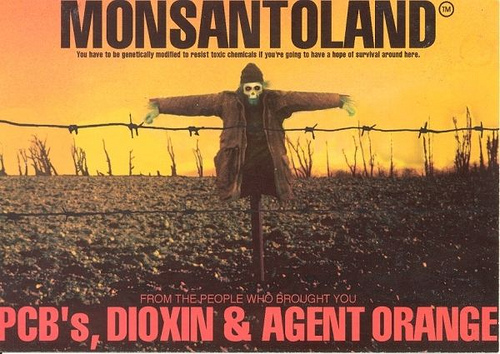

https://arcanumdeepsecrets.files.wordpress.com/2010/07/gmo.jpg


Here's another one; Do you think maybe the chemtrails have something to do with why nobody gives a fuck about anything anymore?  There are literally so many vile, disgusting things going on in the world just now, you'd think our collective heads would explode from the cognitive dissonance & we'd be filling the streets in protest.  Instead we're just the walking dead; going thru the motions to get to payday, never thinking much beyond that.  Why do we permit this insanity?  Isn't there some kind of criteria we could use to screen out these parasites?  You'd think there would be, right?!?  Not so much. 

Tricky Dick taught us that legal is what you get away with.

Now whenever anyone starts talking about actually changing things up a bit, I think everyone just automatically gives up without trying, simply because we're programmed to believe we can't fight city hall...and a hundred other similar things that got crammed in our heads from birth.  People think changing things would be super difficult, and complicated, but that's just more propaganda. 

I wonder what would happen if the American people ever reached the same consensus at the same time.  What if millions of us just said "no more!" with a single voice while filling the streets and bringing commerce to a halt for like a week, just to make a point?  By now we should know that our protests (feeble as they are) always fall on deaf ears.  Cut off their flow of income for a few days and I guarantee they'll listen.  Deprive them of their income for a little longer, and they'll be ready for compromise. 

My daughter, and # 1 granddaughter are coming for a visit next month; and I find my anticipation of the reunion has dusted off memories of being around my grandmother, (and the heavenly blueberry muffins she used to make)...and I realize that I am not living in the world she envisioned for me, not even close.  Like always, she never really had much of a say in how things are done.

I said that bringing about change doesn't have to be complicated and difficult, and here is one way we might conceivably bring it about ... The Grandparent Test.

 Here's how it would work.  Before new policies, politicians or energy technologies could be permitted they'd have to pass the Grandparent Test, which is beautiful in it's simplicity.  If it is something that a grandparent would not want in their grandkids future; it doesn't happen.  No bribes, no legal loopholes, no bullshit. 

Think we could do that in under 15 years??

Grandma always used to remind me that in America, anyone could grow up to be president; however the reality is that the only president not picked by the illuminati, was Jimmy Carter.  What if those who would be president had to pass the grandparent test to gain that office?  Do you think maybe we'd get better results?  Can the love of a grandparent trump evil greedy bastards?  Maybe it's the only force that can!  Maybe if there was just more time we could find out.

 If we could just evolve fast enough.

Now of course being a grandparent can't be the only criteria, because clearly congress, government & big business are full of them; most of whom are also lawyers! Government & congress are supposed to be representative of the nation's citizenry in general, yet few of us are lawyers!  Why so many lawyers in congress?  It’s like having special interests representing themselves, not us.  How about dumping all those greedy white lawyers and stacking congress with scientists, environmentalists, and salt of the earth grandparents who love family more than power and wealth.  woulda, shoulda, coulda.

It's hard not to dwell upon the kind of world my grandchildren will inherit, and the way our generation has failed theirs.  We had our shot at turning things around during the summer of love nearly fifty years ago, and we blew it.  

http://www.evilcorp.tv/images/personnel/person7-big.jpg
We let the bastards intimidate us right out of our future, and humanities evolution. 

Part of the blame here falls directly upon Timothy Leary; who had the opportunity to galvanize every one of us back then, but instead he sold out and backed away.  I can imagine the kind of world this might have become if on that sunny San Francisco day he'd said, "turn on, tune in & take over" instead of urging us to get stoned and drop out.  He conned a generation into forsaking their stake in the future.  Nice job there Timmy!

There is enough Helium-3 on the moon to supply 70% of earth's energy needs with clean fusion energy; so why aren't we up there mining it instead of polluting our planet with toxic fossil fuels, and starting serial wars for petroleum?   Why do we silently finance wars of conquest across the globe, sacrificing our young men and women on the altar of greed?  If we spoke with a single voice, we could divert that money to fully funding our schools, giving back their music and arts programs.  I think that would pass the grandparent test faster than everlasting wars. 
Is Guy McPherson right with his estimate of human extinction, maybe yes maybe no, but certainly he very likely knows much more than most of us do.  Whether we bring about our own demise, or fall to some HELE (Human Extinction Level Event) such as coronal mass ejection, asteroid impact, gamma ray burst makes little difference in the end; We'll still be gone.  With that said, whether we meet our doom in 15 years or 150; we still need to make some drastic, quick changes around this place.

It is long past time to dump these depraved, greedy bastards who use us as a renewable resource; We need to be investing everything we have towards more life affirming ways of being on this planet.  We need to restore the balance with nature, act in concert with Gaia not against her.  We need to heal together.  We need peace.

 If we should find that creating the world we'd have our grandchildren inherit is just too much work, too much inconvenience, then we may as well embrace the race to extinction and party like it's 2030 - and hope for a better incarnation next time.

Bill Nye's Global Meltdown


The Murder of David Kassic


- Scroll down through ‘Older Posts’ at the end of each section


Hope you like this not for profit site -
It takes hours of work every day by a genuinely incapacitated invalid to maintain, write, edit, research, illustrate and publish this website from a tiny cabin in a remote forest
Like what we do? Please give anything you can -  
Contribute any amount and receive at least one New Illuminati eBook!
(You can use a card securely if you don’t use Paypal)
Please click below -


Spare Bitcoin change?


Xtra Images – https://arcanumdeepsecrets.files.wordpress.com/2010/07/gmo.jpg
http://www.evilcorp.tv/images/personnel/person7-big.jpg

Videos - https://youtu.be/ra1M7XyyIDA


For further enlightening information enter a word or phrase into the random synchronistic search box @ the top left of http://nexusilluminati.blogspot.com


And see


 New Illuminati on Facebook - https://www.facebook.com/the.new.illuminati

New Illuminati Youtube Channel -  https://www.youtube.com/user/newilluminati/playlists

New Illuminati’s OWN Youtube Videos -  
New Illuminati on Google+ @ For New Illuminati posts - https://plus.google.com/u/0/+RamAyana0/posts

New Illuminati on Twitter @ www.twitter.com/new_illuminati


New Illuminations –Art(icles) by R. Ayana @ http://newilluminations.blogspot.com

The Her(m)etic Hermit - http://hermetic.blog.com


DISGRUNTLED SITE ADMINS PLEASE NOTE –
We provide a live link to your original material on your site (and links via social networking services) - which raises your ranking on search engines and helps spread your info further!

This site is published under Creative Commons (Attribution) CopyRIGHT (unless an individual article or other item is declared otherwise by the copyright holder). Reproduction for non-profit use is permitted & encouraged - if you give attribution to the work & author and include all links in the original (along with this or a similar notice).

Feel free to make non-commercial hard (printed) or software copies or mirror sites - you never know how long something will stay glued to the web – but remember attribution!

If you like what you see, please send a donation (no amount is too small or too large) or leave a comment – and thanks for reading this far…

Live long and prosper! Together we can create the best of all possible worlds…


From the New Illuminati – http://nexusilluminati.blogspot.com

Sunday, 8 December 2013

Last Words to a Planet in Decline


Last Words to a Planet in Decline
Epistle to the Ecotopians

http://farm8.staticflickr.com/7408/10459122806_d7b522f3f3_c.jpg


Every now and then, something truly out of the ordinary comes your way.  In my case at TomDispatch, it was words from a dead man -- not figuratively speaking, but literally -- and they arrived in my email in the spring of 2012.  That man, who died of cancer in April 2012, had had a way of peering into the future with a striking sense of what might lie ahead of us.  Knowing he would die, Ernest ("Chick") Callenbach, the author of, among other works, the groundbreaking utopian novel Ecotopia, looked into his and our past, assessed our present, focusing on our strengths and weaknesses, and peered for a final time into the unknown, into a future he would never experience.  I published his “Epistle to the Ecotopians” that May and today, as the second “best of TomDispatch” post for a waning August 2013, I offer it once again, including my introduction of that moment.  It’s a piece that, to my mind, like a fine wine, has aged well. Tom]


To all brothers and sisters who hold the dream in their hearts of a future world in which humans and all other beings live in harmony and mutual support -- a world of sustainability, stability, and confidence. A world something like the one I described, so long ago, in Ecotopia and Ecotopia Emerging.


As I survey my life, which is coming near its end, I want to set down a few thoughts that might be useful to those coming after. It will soon be time for me to give back to Gaia the nutrients that I have used during a long, busy, and happy life. I am not bitter or resentful at the approaching end; I have been one of the extraordinarily lucky ones. So it behooves me here to gather together some thoughts and attitudes that may prove useful in the dark times we are facing: a century or more of exceedingly difficult times.

How will those who survive manage it? What can we teach our friends, our children, our communities? Although we may not be capable of changing history, how can we equip ourselves to survive it?

I contemplate these questions in the full consciousness of my own mortality. Being offered an actual number of likely months to live, even though the estimate is uncertain, mightily focuses the mind. On personal things, of course, on loved ones and even loved things, but also on the Big Picture.

But let us begin with last things first, for a change. The analysis will come later, for those who wish it.

Hope. Children exude hope, even under the most terrible conditions, and that must inspire us as our conditions get worse. Hopeful patients recover better. Hopeful test candidates score better. Hopeful builders construct better buildings. Hopeful parents produce secure and resilient children. In groups, an atmosphere of hope is essential to shared successful effort: “Yes, we can!” is not an empty slogan, but a mantra for people who intend to do something together -- whether it is rescuing victims of hurricanes, rebuilding flood-damaged buildings on higher ground, helping wounded people through first aid, or inventing new social structures (perhaps one in which only people are “persons,” not corporations). We cannot know what threats we will face. But ingenuity against adversity is one of our species’ built-in resources. We cope, and faith in our coping capacity is perhaps our biggest resource of all.

Mutual support. The people who do best at basic survival tasks (we know this experimentally, as well as intuitively) are cooperative, good at teamwork, often altruistic, mindful of the common good. In drastic emergencies like hurricanes or earthquakes, people surprise us by their sacrifices -- of food, of shelter, even sometimes of life itself. Those who survive social or economic collapse, or wars, or pandemics, or starvation, will be those who manage scarce resources fairly; hoarders and dominators win only in the short run, and end up dead, exiled, or friendless. So, in every way we can we need to help each other, and our children, learn to be cooperative rather than competitive; to be helpful rather than hurtful; to look out for the communities of which we are a part, and on which we ultimately depend.

Practical skills. With the movement into cities of the U.S. population, and much of the rest of the world’s people, we have had a massive de-skilling in how to do practical tasks. When I was a boy in the country, all of us knew how to build a tree house, or construct a small hut, or raise chickens, or grow beans, or screw pipes together to deliver water. It was a sexist world, of course, so when some of my chums in eighth grade said we wanted to learn girls’ “home ec” skills like making bread or boiling eggs, the teachers were shocked, but we got to do it. There was widespread competence in fixing things -- impossible with most modern contrivances, of course, but still reasonable for the basic tools of survival: pots and pans, bicycles, quilts, tents, storage boxes.

We all need to learn, or relearn, how we would keep the rudiments of life going if there were no paid specialists around, or means to pay them. Every child should learn elementary carpentry, from layout and sawing to driving nails. Everybody should know how to chop wood safely, and build a fire. Everybody should know what to do if dangers appear from fire, flood, electric wires down, and the like. Taking care of each other is one practical step at a time, most of them requiring help from at least one other person; survival is a team sport.

Organize. Much of the American ideology, our shared and usually unspoken assumptions, is hyper-individualistic. We like to imagine that heroes are solitary, have super powers, and glory in violence, and that if our work lives and business lives seem tamer, underneath they are still struggles red in blood and claw. We have sought solitude on the prairies, as cowboys on the range, in our dependence on media (rather than real people), and even in our cars, armored cabins of solitude. We have an uneasy and doubting attitude about government, as if we all reserve the right to be outlaws. But of course human society, like ecological webs, is a complex dance of mutual support and restraint, and if we are lucky it operates by laws openly arrived at and approved by the populace.

If the teetering structure of corporate domination, with its monetary control of Congress and our other institutions, should collapse of its own greed, and the government be unable to rescue it, we will have to reorganize a government that suits the people. We will have to know how to organize groups, how to compromise with other groups, how to argue in public for our positions.

 It turns out that “brainstorming,” a totally noncritical process in which people just throw out ideas wildly, doesn’t produce workable ideas. In particular, it doesn’t work as well as groups in which ideas are proposed, critiqued, improved, debated. But like any group process, this must be protected from domination by powerful people and also over-talkative people. When the group recognizes its group power, it can limit these distortions. Thinking together is enormously creative; it has huge survival value.

Learn to live with contradictions. These are dark times, these are bright times. We are implacably making the planet less habitable. Every time a new oil field is discovered, the press cheers: “Hooray, there is more fuel for the self-destroying machines!” We are turning more land into deserts and parking lots. We are wiping out innumerable species that are not only wondrous and beautiful, but might be useful to us. We are multiplying to the point where our needs and our wastes outweigh the capacities of the biosphere to produce and absorb them. And yet, despite the bloody headlines and the rocketing military budgets, we are also, unbelievably, killing fewer of each other proportionately than in earlier centuries.

We have mobilized enormous global intelligence and mutual curiosity, through the Internet and outside it. We have even evolved, spottily, a global understanding that democracy is better than tyranny, that love and tolerance are better than hate, that hope is better than rage and despair, that we are prone, especially in catastrophes, to be astonishingly helpful and cooperative.

We may even have begun to share an understanding that while the dark times may continue for generations, in time new growth and regeneration will begin. In the biological process called “succession,” a desolate, disturbed area is gradually, by a predictable sequence of returning plants, restored to ecological continuity and durability. When old institutions and habits break down or consume themselves, new experimental shoots begin to appear, and people explore and test and share new and better ways to survive together.

It is never easy or simple. But already we see, under the crumbling surface of the conventional world, promising developments: new ways of organizing economic activity (cooperatives, worker-owned companies, nonprofits, trusts), new ways of using low-impact technology to capture solar energy, to sequester carbon dioxide, new ways of building compact, congenial cities that are low (or even self-sufficient) in energy use, low in waste production, high in recycling of almost everything. A vision of sustainability that sometimes shockingly resembles Ecotopia is tremulously coming into existence at the hands of people who never heard of the book.

http://farm3.staticflickr.com/2808/9852890924_30c3ace7ff_h.jpg
___________________

Now in principle, the Big Picture seems simple enough, though devilishly complex in the details. We live in the declining years of what is still the biggest economy in the world, where a looter elite has fastened itself upon the decaying carcass of the empire. It is intent on speedily and relentlessly extracting the maximum wealth from that carcass, impoverishing our former working middle class. But this maggot class does not invest its profits here. By law and by stock-market pressures, corporations must seek their highest possible profits, no matter the social or national consequences -- which means moving capital and resources abroad, wherever profit potential is larger. As Karl Marx darkly remarked, “Capital has no country,” and in the conditions of globalization his meaning has come clear.

The looter elite systematically exports jobs, skills, knowledge, technology, retaining at home chiefly financial manipulation expertise: highly profitable, but not of actual productive value. Through “productivity gains” and speedups, it extracts maximum profit from domestic employees; then, firing the surplus, it claims surprise that the great mass of people lack purchasing power to buy up what the economy can still produce (or import).

Here again Marx had a telling phrase: “Crisis of under-consumption.” When you maximize unemployment and depress wages, people have to cut back. When they cut back, businesses they formerly supported have to shrink or fail, adding their own employees to the ranks of the jobless, and depressing wages still further. End result: something like Mexico, where a small, filthy rich plutocracy rules over an impoverished mass of desperate, uneducated, and hopeless people.

Barring unprecedented revolutionary pressures, this is the actual future we face in the United States, too. As we know from history, such societies can stand a long time, supported by police and military control, manipulation of media, surveillance and dirty tricks of all kinds. It seems likely that a few parts of the world (Germany, with its worker-council variant of capitalism, New Zealand with its relative equality, Japan with its social solidarity, and some others) will remain fairly democratic.

The U.S., which has a long history of violent plutocratic rule unknown to the textbook-fed, will stand out as the best-armed Third World country, its population ill-fed, ill-housed, ill-educated, ill-cared for in health, and increasingly poverty-stricken: even Social Security may be whittled down, impoverishing tens of millions of the elderly.

As empires decline, their leaders become increasingly incompetent -- petulant, ignorant, gifted only with PR skills of posturing and spinning, and prone to the appointment of loyal idiots to important government positions. Comedy thrives; indeed writers are hardly needed to invent outrageous events.

We live, then, in a dark time here on our tiny precious planet. Ecological devastation, political and economic collapse, irreconcilable ideological and religious conflict, poverty, famine: the end of the overshoot of cheap-oil-based consumer capitalist expansionism.

If you don’t know where you’ve been, you have small chance of understanding where you might be headed. So let me offer a capsule history for those who, like most of us, got little help from textbook history.

At 82, my life has included a surprisingly substantial slice of American history. In the century or so up until my boyhood in Appalachian central Pennsylvania, the vast majority of Americans subsisted as farmers on the land. Most, like people elsewhere in the world, were poor, barely literate, ill-informed, short-lived.  Millions had been slaves. Meanwhile in the cities, vast immigrant armies were mobilized by ruthless and often violent “robber baron” capitalists to build vast industries that made things: steel, railroads, ships, cars, skyscrapers.

Then, when I was in grade school, came World War II. America built the greatest armaments industry the world had ever seen, and when the war ended with most other industrial countries in ruins, we had a run of unprecedented productivity and prosperity. Thanks to strong unions and a sympathetic government, this prosperity was widely shared: a huge working middle class evolved -- tens of millions of people could afford (on one wage) a modest house, a car, perhaps sending a child to college. This era peaked around 1973, when wages stagnated, the Vietnam War took a terrible toll in blood and money, and the country began sliding rightward.


In the next epoch, which we are still in and which may be our last as a great nation, capitalists who grew rich and powerful by making things gave way to a new breed: financiers who grasped that you could make even more money by manipulating money. (And by persuading Congress to subsidize them -- the system should have been called Subsidism, not Capitalism.) They had no concern for the productivity of the nation or the welfare of its people; with religious fervor, they believed in maximizing profit as the absolute economic goal. They recognized that, by capturing the government through the election finance system and removing government regulation, they could turn the financial system into a giant casino.

Little by little, they hollowed the country out, until it was helplessly dependent on other nations for almost all its necessities. We had to import significant steel components from China or Japan. We came to pay for our oil imports by exporting food (i.e., our soil). Our media and our educational system withered. Our wars became chronic and endless and stupefyingly expensive. Our diets became suicidal, and our medical system faltered; life expectancies began to fall.

And so we have returned, in a sort of terrible circle, to something like my boyhood years, when President Roosevelt spoke in anger of “one third of a nation ill-housed, ill-fed, ill-clothed.” A large and militant contingent of white, mostly elderly, Anglo-Saxon, Protestant right wingers, mortally threatened by their impending minority status and pretending to be liberty-lovers, desperately seek to return us still further back.

Americans like to think of ours as an exceptional country, immune through geographical isolation and some kind of special virtue to the tides of history. Through the distorted lens of our corporate media, we possess only a distorted view of what the country is really like now. In the next decades, we shall see whether we indeed possess the intelligence, the strength, and the mutual courage to break through to another positive era.

No futurist can foresee the possibilities. As empires decay, their civilian leaderships become increasingly crazed, corrupt, and incompetent, and often the military (which is after all a parasite of the whole nation, and has no independent financial base like the looter class) takes over. Another possible scenario is that if the theocratic red center of the country prevails in Washington, the relatively progressive and prosperous coastal areas will secede in self-defense.

Ecotopia is a novel, and secession was its dominant metaphor: how would a relatively rational part of the country save itself ecologically if it was on its own? As Ecotopia Emerging puts it, Ecotopia aspired to be a beacon for the rest of the world. And so it may prove, in the very, very long run, because the general outlines of Ecotopia are those of any possible future sustainable society.

The "ecology in one country" argument was an echo of an actual early Soviet argument, as to whether "socialism in one country" was possible. In both cases, it now seems to me, the answer must be no. We are now fatally interconnected, in climate change, ocean impoverishment, agricultural soil loss, etc., etc., etc. International consumer capitalism is a self-destroying machine, and as long as it remains the dominant social form, we are headed for catastrophe; indeed, like rafters first entering the "tongue" of a great rapid, we are already embarked on it.

When disasters strike and institutions falter, as at the end of empires, it does not mean that the buildings all fall down and everybody dies. Life goes on, and in particular, the remaining people fashion new institutions that they hope will better ensure their survival.

So I look to a long-term process of "succession," as the biological concept has it, where "disturbances" kill off an ecosystem, but little by little new plants colonize the devastated area, prepare the soil for larger and more complex plants (and the other beings who depend on them), and finally the process achieves a flourishing, resilient, complex state -- not necessarily what was there before, but durable and richly productive. In a similar way, experiments under way now, all over the world, are exploring how sustainability can in fact be achieved locally. Technically, socially, economically -- since it is quite true, as ecologists know, that everything is connected to everything else, and you can never just do one thing by itself.

Since I wrote Ecotopia, I have become less confident of humans' political ability to act on commonsense, shared values. Our era has become one of spectacular polarization, with folly multiplying on every hand. That is the way empires crumble: they are taken over by looter elites, who sooner or later cause collapse. But then new games become possible, and with luck Ecotopia might be among them.

Humans tend to try to manage things: land, structures, even rivers. We spend enormous amounts of time, energy, and treasure in imposing our will on nature, on preexisting or inherited structures, dreaming of permanent solutions, monuments to our ambitions and dreams. But in periods of slack, decline, or collapse, our abilities no longer suffice for all this management. We have to let things go.

All things “go” somewhere: they evolve, with or without us, into new forms. So as the decades pass, we should try not always to futilely fight these transformations. As the Japanese know, there is much unnoticed beauty in wabi-sabi -- the old, the worn, the tumble-down, those things beginning their transformation into something else. We can embrace this process of devolution: embellish it when strength avails, learn to love it.

There is beauty in weathered and unpainted wood, in orchards overgrown, even in abandoned cars being incorporated into the earth. Let us learn, like the Forest Service sometimes does, to put unwise or unneeded roads “to bed,” help a little in the healing of the natural contours, the re-vegetation by native plants. Let us embrace decay, for it is the source of all new life and growth.

Ernest Callenbach, author of the classic environmental novel Ecotopia among other works, founded and edited the internationally known journal Film Quarterly.  He died at 83 on April 16th, leaving behind this document on his computer.

Copyright Ernest Callenbach 2012

Thirty-five years later, it was still on my bookshelf in a little section on utopias (as well it should have been, being a modern classic).  A friend had written his name inside the cover and even dated it: August 1976, the month I returned to New York City from years of R&R on the West Coast.  Whether I borrowed it and never returned it or he gave it to me neither of us now remembers, but Ecotopia, the visionary novel 25 publishers rejected before Ernest Callenbach published it himself in 1975, was still there ready to be read again a lifetime later.

Callenbach once called that book “my bet with the future,” and in publishing terms it would prove a pure winner.  To date it has sold nearly a million copies and been translated into many languages.  On second look, it proved to be a book not only ahead of its time but (sadly) of ours as well.  For me, it was a unique rereading experience, in part because every page of that original edition came off in my hands as I turned it.  How appropriate to finish Ecotopia with a loose-leaf pile of paper in a New York City where paper can now be recycled and so returned to the elements.

Callenbach would have appreciated that.  After all, his novel, about how Washington, Oregon, and Northern California seceded from the union in 1979 in the midst of a terrible economic crisis, creating an environmentally sound, stable-state, eco-sustainable country, hasn’t stumbled at all.  It’s we who have stumbled.  His vision of a land that banned the internal combustion engine and the car culture that went with it, turned in oil for solar power (and other inventive forms of alternative energy), recycled everything, grew its food locally and cleanly, and in the process created clean skies, rivers, and forests (as well as a host of new relationships, political, social, and sexual) remains amazingly lively, and somehow almost imaginable -- an approximation, that is, of the country we don’t have but should or even could have.

Callenbach’s imagination was prodigious.  Back in 1975, he conjured up something like C-SPAN and something like the cell phone, among many ingenious inventions on the page.  Ecotopia remains a thoroughly winning book and a remarkable feat of the imagination, even if, in the present American context, the author also dreamed of certain things that do now seem painfully utopian, like a society with relative income equality.

“Chick” -- as he was known, thanks, it turns out, to the chickens his father raised in Appalachian central Pennsylvania in his childhood -- was, like me, an editor all his life.  He founded the prestigious magazine Film Quarterly in 1958.  In the late 1970s, I worked with him and his wife, Christine Leefeldt, on a book of theirs, The Art of Friendship.  He also wrote a successor volume to Ecotopia (even if billed as a prequel), Ecotopia Emerging.  And as he points out in his last piece, today’s TomDispatch post, he, too, has now been recycled.  He died of cancer on April 16th [2012] at the age of 83.

Just days later, his long-time literary agent Richard Kahlenberg wrote me that Chick had left a final document on his computer, something he had been preparing in the months before he knew he would die, and asked if TomDispatch would run it.  Indeed, we would.  It’s not often that you hear words almost literally from beyond the grave -- and eloquent ones at that, calling on all Ecotopians, converted or prospective, to consider the dark times ahead.  Losing Chick’s voice and his presence is saddening.  His words remain, however, as do his books, as does the possibility of some version of the better world he once imagined for us all. Tom

[This document was found on the computer of Ecotopia author Ernest Callenbach (1929-2012) after his death.]


From Tom Dispatch @ http://www.tomdispatch.com/post/175740/best_of_tomdispatch%3A_ernest_callenbach%2C_last_words_to_an_america_in_decline/#more

For more information about saving the world see http://nexusilluminati.blogspot.com/search/label/save%20the%20world
- See ‘Older Posts’ at the end of each section


This is a ‘not for profit’ site -
But if you like what we do please buy us a meal or drink if you can
Donate any amount and receive at least one New Illuminati eBook!
Please click below - 


For further enlightening information enter a word or phrase into the random synchronistic search box @ http://nexusilluminati.blogspot.com

And see


 New Illuminati on Facebook - https://www.facebook.com/the.new.illuminati

New Illuminati Youtube Channel - http://www.youtube.com/user/newilluminati/feed


New Illuminati on Twitter @ www.twitter.com/new_illuminati


The Her(m)etic Hermit - http://hermetic.blog.com


The Prince of Centraxis - http://centraxis.blogspot.com (Be Aware! This link leads to implicate & xplicit concepts & images!)


DISGRUNTLED SITE ADMINS PLEASE NOTE –
We provide a live link to your original material on your site - which raises your ranking on search engines and helps spread your info further! This site is published under Creative Commons Fair Use Copyright (unless an individual article or other item is declared otherwise by copyright holder) – reproduction for non-profit use is permitted & encouraged, if you give attribution to the work & author - and please include a (preferably active) link to the original (along with this or a similar notice).
Feel free to make non-commercial hard (printed) or software copies or mirror sites - you never know how long something will stay glued to the web – but remember attribution! If you like what you see, please send a donation (no amount is too small or too large) or leave a comment – and thanks for reading this far…

Live long and prosper!


From the New Illuminati – http://nexusilluminati.blogspot.com