"All the World's a Stage We Pass Through" R. Ayana

Showing posts with label consciousness expansion. Show all posts

Monday, 30 December 2013

Entheogens and the Development of Culture

Entheogens and the Development of Culture


 http://farm6.staticflickr.com/5501/9819057466_ddf7bd1986_k.jpg


by John A. Rush


 As a collection, Entheogens and the Development of Culture: The Anthropology and Neurobiology of Ecstatic Experience proposes that psychoactive substances have been key components in the development of both human culture and the human brain. The fourteen essays that are included in the collection are written by a number of researchers from across various disciplines, including anthropology, mycology, classics, cultural historians, psychology and biology.

While, academically and perspectively, the writers often appear to be coming from altogether totally different theoretical places, with a myriad of intentions laced within them, they do share the common goal of examining the role of psychoactive substances in the history of human culture. And, as such, provides an interesting argument when taken in its totality.

The question regarding the entheogenic effect on the development of the human brain, while bolstered to some degree by the cultural chapters, is largely formulated in Michael Winkelman’s essay Altered Consciousness and Drugs in Human Evolution. Holding the position that our brains have evolved alongside, and as a result of certain plants and altered states, by way of the serotonergic and dopaminergic systems that can be stimulated by exogenous neurotransmitters—such as those found in Psilocybe mushrooms. Winkleman writes:

“The role of drugs in the evolution of human consciousness must be understood in relationship to effects on the serotonergic system and its roles in overall brain functioning. The alterations of consciousness enhance paleomammilian brain functions and their coordination and integration with the entire brain. Enhanced serotonergic mechanisms contributed to experiences of altered consciousness in humans, embodied in visionary experiences” (Rush 45)

So, the theory goes, the evolution of human consciousness has been, in part, mediated by the exogenous neurotransmitters that humans have sought out and consumed, thereby taking a hand in their own evolution. Taking the theory at face value, for the moment, this leads Winkleman to postulate that, “this expanded associational area improved the brain’s capacity to interface with a variety of other neural mechanisms, including those involved in learning, problem-solving, and memory function” (ibid.). Here, therefore, is the window into culture. From these improved brain functions, art, society and, indeed, organization generally, could develop.

However, as we shall see, the remainder of the essays are less about the role of entheogens generating the capability for culture-creation in humans, but more about the role of entheogens within culture itself. Indeed, if entheogens created the capacity for culture, culture itself embarked on a process of reintegrating entheogens from the newly evolved perspective.

Entheogen discourse is primarily driven by historical analysis, and particularly the religious use of mushrooms within human culture, and while this is also very true of this collection, a number of other substances are discussed, which are worth mentioning first. Chris Bennett and Neil McQueen, both having written extensively on drugs and the bible, offer a chapter entitled Cannabis and the Hebrew Bible, which makes use of Sula Benet’s identification of kaneh bosm—an anointing oil used as an initiatory rite—with cannabis. 

http://farm6.staticflickr.com/5349/9819064716_13475fcbf1_k.jpg Alan Piper, writing The Milk of the Goat Heidrun: An Investigation into the Sacramental Use of Psychoactive Milk and Meat,  examines ethnographic, scriptural, and mythographic records for evidence of human’s observing plant effects in animals, and their subsequent use of un-metabolized chemicals through the consumption of the animals and their products. However, while these connections serve to embed the narrative of a sacramental connection between human culture and psychoactive substances, it is to the specific case of mushrooms that the majority of the book turns.

The interpretation of mythological text takes an important role in two essays: Kevin Feeney’s The Significance of Pharmacological and Biological Indicators in Identifying Historical Uses of Amanita muscaria, and Edzard Klapp’s Ravens’ Bread and Other Manifestations of Fly Agaric in Classical and Biblical Literature. Both follow in the footsteps of the Godfather of entheogens R. Gordon Wasson, so far as centralizing the role of the Amanita muscaria mushroom, and understanding its textual place as being embedded through metaphor and stylized textual ritual. This is a particularly difficult task as it does involve certain suppositions, such as a standard efficacy of the mushroom, and it does take a leap of faith on the readers behalf—especially in regard to the Celtic and Germanic myths. Although, it does make for fascinating reading, and it’s an area I look forward to reading more of in the future. Wasson’s work as a scholar is held in high regard in the book. Feeney writes:

“Wasson’s 1968 opus [Soma: Divine Mushroom of Immortality] remains unparalleled in terms of breadth and sophistication. One of the fundamental contributions of Wasson’s work was the proposition that soma was an entheogen, a point driven home through detailed comparisons of the known effects of entheogenic substances and descriptions of soma inebriation in the Rig Veda” (Rush 280).

However, this attitude toward Wasson is not consistent throughout the collection and, in the final weightily titled essay R. Gordon Wasson: The Man, the Legend, the Myth – Beginning a New History of Magic Mushrooms, Ethnomycology, and the Psychedelic Revolution, by Jan Irvin, there is something of a character assassination. In a nut-shell Irvin claims that Wasson was part of a mind control and propaganda campaign regarding mushrooms and ethnomycology that reached to top levels of government. The conspiracy theory, if true, would put Wasson’s scholarly work under a damning light and, in some respects, pulls the rug out from some of the other researchers’ work included in this collection. One passage from the piece particularly stood out for me: “Those who twist the facts of reality to their own selfish agendas, sacrificing truth and humanity in the process, bring the whole of the world down with them” (Rush 611).

On the other end of the scholarly scale, Mike Jay’s chapter Enter the Jaguar is an excellent examination of the ruins at Chavin de Huanter in the Peruvian Andes, with its evidential symbolic art and its complex temple structure. Jay tentatively, but convincingly, argues that the ruined complex could be understood as a “visionary technology, designed to externalize and intensify these intoxications and to focus them into a particular inner journey” (Rush 331). If so, it demonstrates a highly evolved culture that utilized psychoactive substances in highly respectful manner in a period analogous to the Mysteries of Eleusis. Such feats occurring simultaneously across the globe appear to underline the importance of psychoactive plants in the emergence of human culture.

There are numerous other essays in this collection, too many for this review to fully explicate them all, suffice to say that such learned contributors as the classicist Carl Ruck and mycologist Gastón Guzmán lend a great deal of credibility and insightful analysis, which really helps underpin the collections premise. Personally speaking, I also found Gerrit J. Keizer’s Hildegard of Bingen: Unveiling the Secrets of a Medieval High Priestess and Visionary very interesting as I’d never come across Hildegard before. In conclusion, however, there is much interesting work to get to grips with in Entheogens and the Development of Culture, not least the need for a wider contextual analysis on the development of culture itself (for instance, what role did the development of technology and the rise of leisure time play in conjunction with psychoactives.) But, overall, an engaging and thought-provoking collection.


Entheogens and the Development of CultureOriginally published in 2013 ‘Entheogens and the Development of Culture: The Anthropology and Neurobiology of Ecstatic Experience’ is a collection of essays edited by John A. Rush. Rush has previously authored the books ‘The Mushroom in Christian Art: The Identity of Jesus in the Development of Christianity’, ‘Failed God: Fractured Myth in a Fragile World’ and ‘The Twelve Gates: A Spiritual Passage through the Egyptian Books of the Dead’. This work has been published by North Atlantic Books.


From psychedelic Press UK @ http://psypressuk.com/2013/10/08/entheogens-and-the-development-of-culture-by-john-a-rush-ed/


For more information about entheogens see http://nexusilluminati.blogspot.com/search/label/entheogens
- See ‘Older Posts’ at the end of each section


This is a ‘not for profit’ site -
But if you like what we do please buy us a meal or drink if you can
Donate any amount and receive at least one New Illuminati eBook!
Please click below - 


Videos - http://youtu.be/pSUTS0D_MwQ
http://youtu.be/0qgMFO0KU-I


For further enlightening information enter a word or phrase into the random synchronistic search box @ http://nexusilluminati.blogspot.com


And see


 New Illuminati on Facebook - https://www.facebook.com/the.new.illuminati

New Illuminati Youtube Channel - http://www.youtube.com/user/newilluminati/feed


New Illuminati on Twitter @ www.twitter.com/new_illuminati


The Her(m)etic Hermit - http://hermetic.blog.com


The Prince of Centraxis - http://centraxis.blogspot.com (Be Aware! This link leads to implicate & xplicit concepts & images!)


DISGRUNTLED SITE ADMINS PLEASE NOTE –
We provide a live link to your original material on your site - which raises your ranking on search engines and helps spread your info further! This site is published under Creative Commons Fair Use Copyright (unless an individual article or other item is declared otherwise by copyright holder) – reproduction for non-profit use is permitted & encouraged, if you give attribution to the work & author - and please include a (preferably active) link to the original (along with this or a similar notice).
Feel free to make non-commercial hard (printed) or software copies or mirror sites - you never know how long something will stay glued to the web – but remember attribution! If you like what you see, please send a donation (no amount is too small or too large) or leave a comment – and thanks for reading this far…

Live long and prosper!


From the New Illuminati – http://nexusilluminati.blogspot.com

Sunday, 18 March 2012

Zap your brain into the zone: Fast track to pure focus

Zap your brain into the zone
Fast track to pure focus


Whether you want to smash a forehand like Federer, or just be an Xbox hero, there is a shocking short cut to getting the brain of an expert


Zen and the art of genius <i>(Image: The Red Dress)</i>I'm close to tears behind my thin cover of sandbags as 20 screaming, masked men run towards me at full speed, strapped into suicide bomb vests and clutching rifles. For every one I manage to shoot dead, three new assailants pop up from nowhere. I'm clearly not shooting fast enough, and panic and incompetence are making me continually jam my rifle.

My salvation lies in the fact that my attackers are only a video, projected on screens to the front and sides. It's the very simulation that trains US troops to take their first steps with a rifle, and everything about it has been engineered to feel like an overpowering assault. But I am failing miserably. In fact, I'm so demoralised that I'm tempted to put down the rifle and leave.

Then they put the electrodes on me.

I am in a lab in Carlsbad, California, in pursuit of an elusive mental state known as "flow" - that feeling of effortless concentration that characterises outstanding performance in all kinds of skills.

Flow has been maddeningly difficult to pin down, let alone harness, but a wealth of new technologies could soon allow us all to conjure up this state. The plan is to provide a short cut to virtuosity, slashing the amount of time it takes to master a new skill - be it tennis, playing the piano or marksmanship.

That will be welcome news to anyone embarking on the tortuous road to expertise. According to pioneering research by Anders Ericsson at Florida State University in Tallahassee, it normally takes 10,000 hours of practice to become expert in any discipline. Over that time, your brain knits together a wealth of new circuits that eventually allow you to execute the skill automatically, without consciously considering each action. Think of the way tennis champion Roger Federer, after years of training, can gracefully combine a complicated series of actions - keeping one eye on the ball and the other on his opponent, while he lines up his shot and then despatches a crippling backhand - all in one stunningly choreographed second.

Flow typically accompanies these actions. It involves a Zen-like feeling of intense concentration, with time seeming to stop as you focus completely on the activity in hand. The experience crops up repeatedly when experts describe what it feels like to be at the top of their game, and with years of practice it becomes second nature to enter that state. Yet you don't have to be a pro to experience it - some people report the same ability to focus at a far earlier stage in their training, suggesting they are more naturally predisposed to the flow state than others. This effortless concentration should speed up progress, while the joyful feelings that come with the flow state should help take the sting out of further practice, setting such people up for future success, says Mihaly Csikszentmihalyi at Claremont Graduate University in California. Conversely, his research into the flow state in children showed that, as he puts it, "young people who didn't enjoy the pursuit of the subject they were gifted in, whether it was mathematics or music, stopped developing their skills and reverted to mediocrity."

Despite its potentially crucial role in the development of talent, many researchers had deemed the flow state too slippery a concept to tackle - tainted as it was with mystical, meditative connotations. In the late 1970s, Csikszentmihalyi, then a psychologist at the University of Chicago, helped change that view by showing that the state could be defined and studied empirically. In one groundbreaking study, he interviewed a few hundred talented people, including athletes, artists, chess players, rock climbers and surgeons, enabling him to pin down four key features that characterise flow.

The first is an intense and focused absorption that makes you lose all sense of time. The second is what is known as autotelicity, the sense that the activity you are engaged in is rewarding for its own sake. The third is finding the "sweet spot", a feeling that your skills are perfectly matched to the task at hand, leaving you neither frustrated nor bored. And finally, flow is characterised by automaticity, the sense that "the piano is playing itself", for example.

Exactly what happens in the brain during flow has been of particular interest, but it has been tricky to measure. Csikszentmihalyi took an early stab at it, using electroencephalography (EEG) to measure the brain waves of expert chess players during a game. He found that the most skilled players showed less activity in the prefrontal cortex, which is typically associated with higher cognitive processes such as working memory and verbalisation. That may seem counter-intuitive, but silencing self-critical thoughts might allow more automatic processes to take hold, which would in turn produce that effortless feeling of flow.

Later studies have confirmed these findings and revealed other neural signatures of flow. Chris Berka and her colleagues at Advanced Brain Monitoring in Carlsbad, California, for example, looked at the brain waves of Olympic archers and professional golfers. A few seconds before the archers fired off an arrow or the golfers hit the ball, the team spotted a small increase in what's known as the alpha band, one of the frequencies that arises from the electrical noise of all the brain's neurons (The International Journal of Sport and Society, vol 1, p 87).

This surge in alpha waves, Berka says, is associated with reduced activation of the cortex, and is always more obvious in experts than in novices. "We think this represents focused attention on the target, while other sensory inputs are suppressed," says Berka. She found that these mental changes are accompanied by slower breathing and a lower pulse rate - as you might expect from relaxed concentration.


http://www.ubergizmo.com/wp-content/uploads/2011/04/wired-gaming.jpg 


Defining and characterising the flow state is all very well, but could a novice learn to turn off their critical faculties and focus their attention in this way, at will? If so, would it boost performance? Gabriele Wulf, a kinesiologist at the University of Nevada at Las Vegas, helped to answer this question in 1998, when she and her colleagues examined the way certain athletes move (Journal of Motor Behavior, vol 30, p 169).

At the time, she had no particular interest in the flow state. But Wulf and her colleagues found that they could quickly improve a person's abilities by asking them to focus their attention on an external point away from their body. Aspiring skiers who were asked to do slalom-type movements on a simulator, for example, learned faster if they focused on a marked spot ahead of them. Golfers who focused on the swing of the club were about 20 per cent more accurate than those who focused on their own arms.

Wulf and her colleagues later found that an expert's physical actions require fewer muscle movements than those of a beginner - as seen in the tight, spare motions of top-flight athletes. They also experience less mental strain, a lower heart rate and shallower breathing - all characteristics of the flow state (Human Movement Science, vol 29, p 440).

These findings were borne out in later studies of expert and novice swimmers. Novices who concentrated on an external focus - the water's movement around their limbs - showed the same effortless grace as those with more experience, swimming faster and with a more efficient technique. Conversely, when the expert swimmers focused on their limbs, their performance declined (International Journal of Sport Science & Coaching, vol 6, p 99).

Wulf's findings fit well with the idea that flow - and better learning - comes when you turn off conscious thought. "When you have an external focus, you achieve a more automatic type of control," she says. "You don't think about what you are doing, you just focus on the outcome."

Berka has been taking a different approach to evoke the flow state - her group is training novice marksmen to use neurofeedback. Each person is hooked up to electrodes that tease out and display specific brain waves, along with a monitor that measures their heartbeat. By controlling their breathing and learning to deliberately manipulate the waveforms on the screen in front of them, the novices managed to produce the alpha waves characteristic of the flow state. This, in turn, helped them improve their accuracy at hitting the targets. In fact, the time it took to shoot like a pro fell by more than half (The International Journal of Sport and Society, vol 1, p 87).

But as I found when I tried the method, even neurofeedback has a catch. It takes time and effort to produce really thrumming alpha waves. Just when I thought I had achieved them, they evaporated and I lost my concentration. Might there be a faster way to force my brain into flow? The good news is that there, too, the answer appears to be yes.

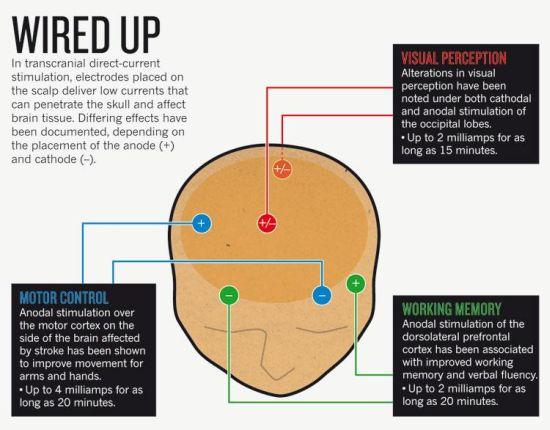
That is why I'm now allowing Michael Weisend, who works at the Mind Research Network in Albuquerque, New Mexico, to hook my brain up to what's essentially a 9-volt battery. He sticks the anode - the positive pole of the battery - to my temple, and the cathode to my left arm. "You're going to feel a slight tingle," he says, and warns me that if I remove an electrode and break the connection, the voltage passing through my brain will blind me for a good few seconds.

Weisend, who is working on a US Defense Advanced Research Projects Agency programme to accelerate learning, has been using this form of transcranial direct current stimulation (tDCS) to cut the time it takes to train snipers. From the electrodes, a 2-milliamp current will run through the part of my brain associated with object recognition - an important skill when visually combing a scene for assailants.

The mild electrical shock is meant to depolarise the neuronal membranes in the region, making the cells more excitable and responsive to inputs. Like many other neuroscientists working with tDCS, Weisend thinks this accelerates formation of new neural pathways during the time that someone practises a skill. The method he is using on me boosted the speed with which wannabe snipers could detect a threat by a factor of 2.3 (Experimental Brain Research, vol 213, p 9).

Mysteriously, however, these long-term changes also seem to be preceded by a feeling that emerges as soon as the current is switched on and is markedly similar to the flow state. "The number one thing I hear people say after tDCS is that time passed unduly fast," says Weisend. Their movements also seem to become more automatic; they report calm, focused concentration - and their performance improves immediately.

It's not yet clear why some forms of tDCS should bring about the flow state. After all, if tDCS were solely about writing new memories, it would be hard to explain the improvement that manifests itself as soon as the current begins to flow.

One possibility is that the electrodes somehow reduce activity in the prefrontal cortex - the area used in critical thought, which Csikszentmihalyi had found to be muted during flow. Roy Hamilton, a neuroscientist at the University of Pennsylvania in Philadelphia, thinks this may happen as a side effect of some forms of tDCS. "tDCS might have much more broad effects than we think it does," he says. He points out that some neurons can mute the signals of other brain cells in their network, so it is possible that stimulating one area of the brain might reduce activity in another.


 Uncertain effect


http://www.kurzweilai.net/images/mindzap.jpg
Others are more sceptical. Arne Dietrich of the American University of Beirut, Lebanon, suspects that learning will be impaired if the frontal cortex isn't initially engaged in the task. What's more, he thinks you would need a specialised type of tDCS to dampen activity in the prefrontal cortex. "But then again, it is not clear what sort of ripple effect tDCS has globally," he concedes, "regardless of which brain area is targeted."

In any case, it is clear that not all forms of tDCS bring about flow. Roi Cohen Kadosh at the University of Oxford certainly saw no signs of it when he placed an anode over the brain regions used in spatial reasoning.

This debate will only be resolved with much more research. For now, I'm intrigued about what I'll experience as I ask Weisend to turn on the current. Initially, there is a slight tingle, and suddenly my mouth tastes like I've just licked the inside of an aluminium can. I don't notice any other effect. I simply begin to take out attacker after attacker. As twenty of them run at me brandishing their guns, I calmly line up my rifle, take a moment to breathe deeply, and pick off the closest one, before tranquilly assessing my next target.

In what seems like next to no time, I hear a voice call out, "Okay, that's it." The lights come up in the simulation room and one of the assistants at Advanced Brain Monitoring, a young woman just out of university, tentatively enters the darkened room.

In the sudden quiet amid the bodies around me, I was really expecting more assailants, and I'm a bit disappointed when the team begins to remove my electrodes. I look up and wonder if someone wound the clocks forward. Inexplicably, 20 minutes have just passed. "How many did I get?" I ask the assistant.

She looks at me quizzically. "All of them."


Diy brain enhancement


Zapping your brain with a small current seems to improve everything from mathematical skills to marksmanship, but for now your best chance of experiencing this boost is to sign up for a lab experiment. Machines that provide transcranial direct current stimulation (tDCS) cost £5000 a pop, and their makers often sell them only to researchers.

That hasn't stopped a vibrant community of DIY tDCS enthusiasts from springing up. Their online forums are full of accounts of their home-made experiments, including hair-curling descriptions of blunders that, in one case, left someone temporarily blind.

What drives people to take such risks? Roy Hamilton, a neuroscientist at the University of Pennsylvania in Philadelphia, thinks it is part of a general trend he calls cosmetic neuroscience, in which people try to tailor their brains to the demands of an increasingly fast-paced world. "In a society where both students and their professors take stimulant medications to meet their academic expectations," he warns, "the potential pressure for the use of cognitive enhancing technologies of all types is very real".

Sally Adee is a technology feature editor at New Scientist

@ http://www.newscientist.com/article/mg21328501.600-zap-your-brain-into-the-zone-fast-track-to-pure-focus.html?full=true


Please Help Keep This Unique Site Online
Donate any amount and receive at least one New Illuminati eBook!


For further enlightening information enter a word or phrase into the search box @  New Illuminati or click on any label/tag at the bottom of the pagehttp://nexusilluminati.blogspot.com


And see


New Illuminati Youtube Channel - http://www.youtube.com/user/newilluminati/feed


The Her(m)etic Hermit - http://hermetic.blog.com


This material is published under Creative Commons Fair Use Copyright (unless an individual item is declared otherwise by copyright holder) – reproduction for non-profit use is permitted & encouraged, if you give attribution to the work & author - and please include a (preferably active) link to the original along with this notice. Feel free to make non-commercial hard (printed) or software copies or mirror sites - you never know how long something will stay glued to the web – but remember attribution! If you like what you see, please send a tiny donation or leave a comment – and thanks for reading this far…

From the New Illuminati – http://nexusilluminati.blogspot.com