"All the World's a Stage We Pass Through" R. Ayana

Showing posts with label anthropocene. Show all posts

Thursday, 28 July 2016

Shattered records show climate change is an emergency today, scientists warn


Shattered records show climate change is an emergency today, scientists warn
Seven climate records set so far in 2016
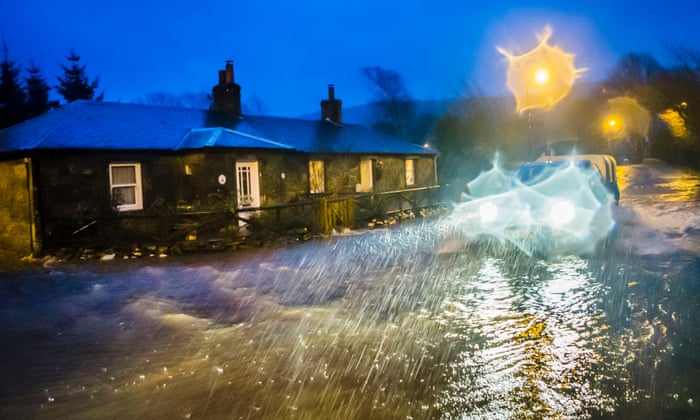
 

Flooding in Straiton, Scotland, in December. Scientists say it will increase in future. Photograph: Danny Lawson/PA


Unprecedented temperature levels mean more heatwaves, flooding, wildfires and hurricanes as experts say global warming is here and affecting us now


May was the 13th month in a row to break temperature records according to figures  that are the latest in 2016’s string of incredible climate records which scientists have described as a bombshell and an emergency.

The series of smashed global records, particularly the extraordinary heat in February and March, has provoked a stunned reaction from climate scientists, who are warning that climate change has reached unprecedented levels and is no longer only a threat for the future.

Alongside the soaring temperatures, other records have tumbled around the world, from vanishing Arctic sea ice to a searing drought in India and the vast bleaching of the Great Barrier Reef. The UK has experienced record flooding that has devastated communities across the country and scientists predict that the flash floods seen by parts of the country in recent days will increase in future.
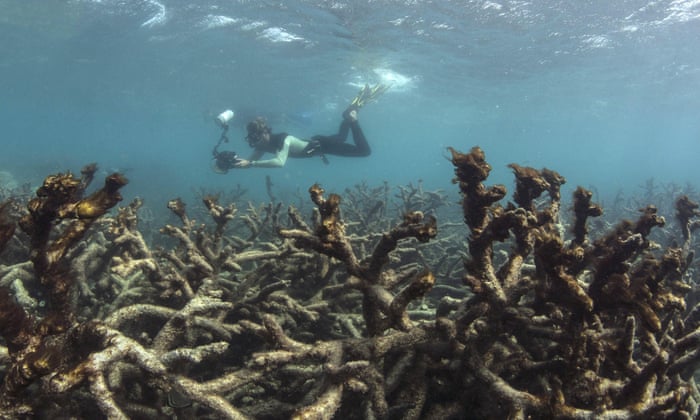

 
Aftermath of coral bleaching in the Great Barrier Reef, which has seen an estimated 22% of the reef’s corals die. Photograph: Xl Catlin Seaview Survey/EPA


“The impacts of human-caused climate change are no longer subtle – they are playing out, in real time, before us,” says Prof Michael Mann, at Penn State University in the US. “They serve as a constant reminder now of how critical it is that we engage in the actions necessary to avert ever-more dangerous and potentially irreversible warming of the planet.”

It was just last December when the world’s nations sealed a deal in Paris to defeat global warming but Prof Stefan Rahmstorf, at the Potsdam Institute for Climate Impact Research in Germany, says: “These [records] are very worrying signs and I think it shows we are on a crash course with the Paris targets unless we change course very, very fast. I hope people realise that global warming is not something down the road, but it is here now and it affecting us now.”

“What is happening right now is we are catapulting ourselves out of the Holocene, which is the geological epoch that human civilisation has been able to develop in, because of the relatively stable climate,” says Rahmstorf. “It allowed us to invent agriculture, rather than living as nomads. It allowed a big population growth, it allowed the foundation of cities, all of which required a stable climate.”
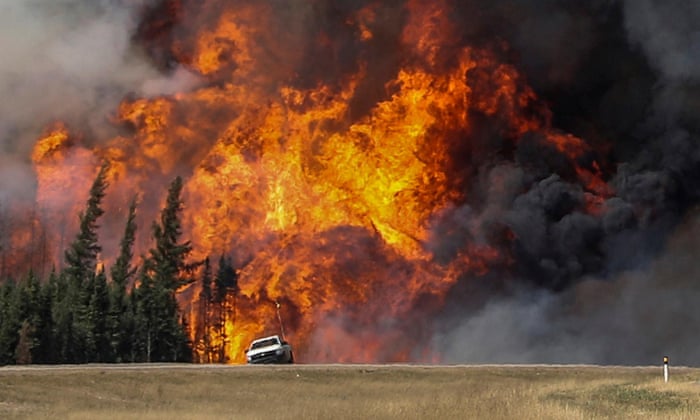

 
Smoke and flames from the wildfires erupt behind a car on the highway near Fort McMurray, Alberta, Canada. Photograph: Mark Blinch/Reuters


But the spikes in global surface temperatures in recent months have been anything but stable. They did not just break the records, they obliterated them. “The numbers are completely unprecedented,” says Adam Scaife, at the Met Office in the UK. “They really stick out like a sore thumb.”

The scorching temperatures mean 2016 is all but certain to be the hottest year ever recorded, beating the previous hottest year in 2015, which itself beat 2014. This run of three record years is also unprecedented and, without climate change, would be a one in a million chance. Scaife says: “Including this year so far, 16 of the 17 warmest years on record have been since 2000 – it’s a shocking statistic.”

Thermometer records go back to 1880, but ice cores, tree rings and corals show global warming driven by humanity’s burning of fossil fuels and forests has left the planet at its hottest for at least 5,000 years. “If we are not above this [temperature] already, we will be in 10 or 20 years’ time and then you have to go back 120,000 years to find higher temperatures than present,” says Rahmstorf.

Another shattered record is the amount of carbon dioxide in the atmosphere, which is on course to rise by a record amount this year, leaving the symbolic landmark of 400 parts per million to history. “We know from Antarctic ice cores that go back almost a million years that CO2 was never even remotely as high as this,” says Rahmstorf, and the rate at which humanity is emitting CO2 is the fastest for 66m years.

Fast-rising CO2 levels are almost entirely the reason for the record-busting year. But the natural climate phenomenon called El Niño has played a part. Cyclical changes in ocean temperatures over decades lead to El Niños during which stored heat is released from the oceans, impacting temperatures and weather around the globe.
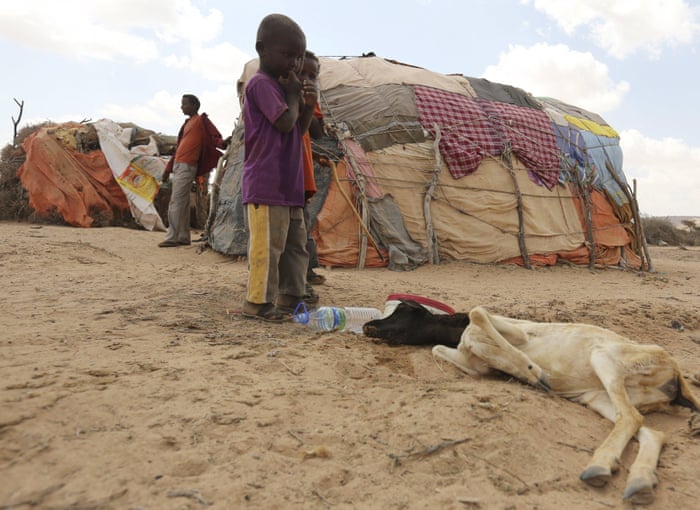

 
Children look at their sheep affected by the El Nino-related drought at a temporary shelter in Somalia’s semi-autonomous Somaliland region. Photograph: Feisal Omar/Reuters


Scientists agree about a fifth of the temperature rise seen in recent months is due to El Niño. However Scaife says: “I suspect some of the months would have still been records, even without the El Niño”. He points out that 1998 saw an ever bigger El Niño, resulting in a record hot year, but that this has now been far surpassed: “It is not even in the running anymore, falling way down the list.”

El Niño is now waning into to its opposite phase, called La Niña. But that does not allay the scientists’ climate concerns: “The La Niña will not be as cool as the El Niño was warm. We are very, very sure of that,” says Scaife. “It probably means that 2017 will not be a record year, but compared to other La Niña years, it is likely to be much warmer than normal.”

Furthermore, there may be more to the record-breaking series than meets the eye. “There is something more going on than the usual global warming trend and El Niño, because in the past El Niño has led to single years breaking records, but it has not caused several years in a row to break records,” says Rahmstorf.

“There is some unexplained part to this and it is concerning, because we don’t understand it and it is hotter than expected,” he says. “I hope the data coming in the next six months or so will bring us some important clues.”

The heat so far has already had major impacts, including a record temperature of 51C in India amid a serious drought and a record warm autumn in Australia, as well as many in the US. “It is in my view highly unlikely that we would be seeing record drought, like we’re seeing in California, record flooding in Texas, unprecedented wildfires in western North America, and the strongest recorded hurricanes in both the northern and southern hemisphere were it not for the impact of human-caused global warming,” says Mann.

Killer heatwaves are increasing too, which is the clearest impact of global warming, says Rahmstorf: “Our analysis of monthly heat records around the globe shows they now occur five times as often. It is those monthly heat records that are representative of heatwaves that last for weeks on end and they are ones that take the highest death toll.”
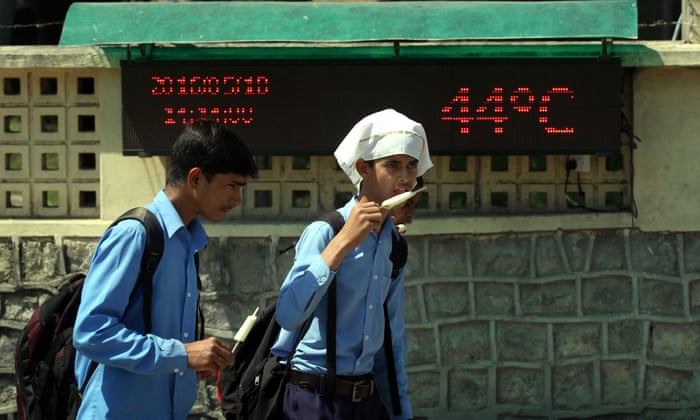

 
Indian schoolchildren eat ice cream as the country suffers a severe heatwave. Photograph: Jaipal Singh/EPA


The UK has been affected too, with December breaking temperature and rainfall records.

“Climate change means more intense rainfall and therefore an increased risk of flooding,” says Bob Ward, policy director at the London School of Economics’ Grantham Research Institute on Climate Change and the Environment.

“The government, which got caught out by two record wet winters in the last three, has suddenly woken up to the fact, which is why they have set up the National Flood Resilience Review. It is now something we are all going to have to come to terms with in the UK.”

Ward says seeing the records broken may mean more people make the connection between action on to cut emissions, such as support for green energy, and the impacts of global warming. He says the global climate deal agreed in December shows every government already knows this is a problem that needs urgent action, but that the high temperatures already occurring will increase the emphasis on adapting to extreme weather events in addition to cutting carbon emissions.

“The impacts we’re beginning to see are just the start and we know we are going to be facing a worsening situation for at least the next couple of decades even if we do cut emissions,” Ward says.

“What’s worrying [about the record-breaking 2016] is that we are in unprecedented territory and we don’t really know what the consequences will be,” he says. “There are likely to be plenty of surprises, some of which will be nasty.”


Top Climate Expert: Crisis is Worse Than We Think & Scientists Are Self-Censoring to Downplay Risk

(15:38)


Climate Change Goes Past Point Of No Return

(13:15)


For more information about catastrophic climate change see http://nexusilluminati.blogspot.com/search/label/climate%20change  
- Scroll down through ‘Older Posts’ at the end of each section


Do you LIKE this uniquely informative site?
Hours of effort by a genuinely incapacitated invalid are required every day to maintain, write, edit, research, illustrate, moderate and publish this website from a tiny cabin in a remote forest.
Now that most people use ad blockers and view these posts on phones and other mobile devices, sites like this earn an ever shrinking pittance from advertising sponsorship.
This site needs your help.
Like what you see? Please give anything you can -  
Contribute any amount and receive at least one New Illuminati eBook!
(You can use a card securely if you don’t use Paypal)
Please click below -


And it costs nothing to share this post on Social Media!
Dare to care and share - YOU are our only advertisement!


For further enlightening information enter a word or phrase into the random synchronistic search box @ the top left of http://nexusilluminati.blogspot.com


And see


 New Illuminati on Facebook - https://www.facebook.com/the.new.illuminati

New Illuminati Youtube Channel -  https://www.youtube.com/user/newilluminati/playlists

New Illuminati’s OWN Youtube Videos -  
New Illuminati on Google+ @ For New Illuminati posts - https://plus.google.com/u/0/+RamAyana0/posts

New Illuminati on Twitter @ www.twitter.com/new_illuminati


New Illuminations –Art(icles) by R. Ayana @ http://newilluminations.blogspot.com

The Her(m)etic Hermit - http://hermetic.blog.com


DISGRUNTLED SITE ADMINS PLEASE NOTE –
We provide a live link to your original material on your site (and links via social networking services) - which raises your ranking on search engines and helps spread your info further!

This site is published under Creative Commons (Attribution) CopyRIGHT (unless an individual article or other item is declared otherwise by the copyright holder). Reproduction for non-profit use is permitted & encouraged - if you give attribution to the work & author and include all links in the original (along with this or a similar notice).

Feel free to make non-commercial hard (printed) or software copies or mirror sites - you never know how long something will stay glued to the web – but remember attribution!

If you like what you see, please send a donation (no amount is too small or too large) or leave a comment – and thanks for reading this far…

Live long and prosper! Together we can create the best of all possible worlds…


From the New Illuminati – http://nexusilluminati.blogspot.com

Saturday, 21 May 2016

Rewilding and Preserving the World


Rewilding and Preserving the World
Setting aside half the Earth for ‘rewilding’: the ethical dimension


A much-anticipated book in conservation and natural science circles is EO Wilson’s Half-Earth: Our Planet’s Fight for Life, which is due early next year. It builds on his proposal to set aside half the Earth for the preservation of biodiversity.

The famous biologist and naturalist would do this by establishing huge biodiversity parks to protect, restore and connect habitats at a continental scale. Local people would be integrated into these parks as environmental educators, managers and rangers – a model drawn from existing large-scale conservation projects such as Area de Conservación Guanacaste (ACG) in northwestern Costa Rica.

The backdrop for this discussion is that we are in the sixth great extinction event in earth’s history. More species are being lost today than at any time since the end of the dinosaurs. There is no mystery as to why this is happening: it is a direct result of human depredations, habitat destruction, overpopulation, resource depletion, urban sprawl and climate change.

Wilson is one of the world’s premier natural scientists – an expert on ants, the father of island biogeography, apostle of the notion that humans share a bond with other species (biophilia) and a herald about the danger posed by extinction. On these and other matters he is also an eloquent writer, having written numerous books on biodiversity, science, and society. So when Wilson started to talk about half-Earth several years ago, people started to listen.

As a scholar of ethics and public policy with an interest in animals and the environment, I have been following the discussion of half-Earth for some time. I like the idea and think it is feasible. Yet it suffers from a major blind spot: a human-centric view on the value of life. Wilson’s entry into this debate, and his seeming evolution on matters of ethics, is an invitation to explore how people ought to live with each other, other animals and the natural world, particularly if vast tracts are set aside for wildlife.


The ethics of Wilson’s volte-face


I heard Wilson speak for the first time in Washington, DC in the early 2000s. At that talk, Wilson was resigned to the inevitable loss of much of the world’s biodiversity. So he advocated a global biodiversity survey that would sample and store the world’s biotic heritage. In this way, we might still benefit from biodiversity’s genetic information in terms of biomedical research, and perhaps, someday, revive an extinct species or two.

Not a bad idea in and of itself. Still, it was a drearily fatalistic speech, and one entirely devoid of any sense of moral responsibility to the world of nonhuman animals and nature.

What is striking about Wilson’s argument for half-Earth is not the apparent about-face from cataloging biodiversity to restoring it. It is the moral dimension he attaches to it. In several interviews, he references the need for humanity to develop an ethic that cares about planetary life, and does not place the wants and needs of a single species (Homo sapiens sapiens) above the well-being of all other species.


The half-Earth proposal prompts people to consider the role of humans in nature. jene/flickr, CC BY-NC-ND


To my ear, this sounds great, but I am not exactly sure how far it goes. In the past, Wilson’s discussions of conservation ethics appear to me clearly anthropocentric. They espouse the notion that we are exceptional creatures at the apex of evolution, the sole species that has intrinsic value in and of ourselves, and thus we are to be privileged above all other species.

In this view, we care about nature and biodiversity only because we care about ourselves. Nature is useful for us in the sense of resources and ecological services, but it has no value in and of itself. In ethics talk, people have intrinsic value while nature’s only value is what it can do for people – extrinsic value.

For example, in his 1993 book The Biophilia Hypothesis, Wilson argues for “the necessity of a robust and richly textured anthropocentric ethics apart from the issues of rights [for other animals or ecosystems] – one based on the hereditary needs of our own species. In addition to the well-documented utilitarian potential of wild species, the diversity of life has immense aesthetic and spiritual value.”

The passage indicates Wilson’s long-held view that biodiversity is important because of what it does for humanity, including the resources, beauty and spirituality people find in nature. It sidesteps questions of whether animals and the rest of nature have intrinsic value apart from human use.

His evolving position, as reflected in the half-Earth proposal, seems much more in tune with what ethicist call non-anthropocentrism – that humanity is simply one marvelous but no more special outcome of evolution; that other beings, species and/or ecosystems also have intrinsic value; and that there is no reason to automatically privilege us over the rest of life.

Consider this recent statement by Wilson:

What kind of a species are we that we treat the rest of life so cheaply? There are those who think that’s the destiny of Earth: we arrived, we’re humanizing the Earth, and it will be the destiny of Earth for us to wipe humans out and most of the rest of biodiversity. But I think the great majority of thoughtful people consider that a morally wrong position to take, and a very dangerous one.

The non-anthropocentric view does not deny that biodiversity and nature provide material, aesthetic and spiritual “resources.” Rather, it holds there is something more – that the community of life has value independent of the resources it provides humanity. Non-anthropocentric ethics requires, therefore, a more caring approach to people’s impact on the planet. Whether Wilson is really leaving anthropocentrism behind, time will tell. But for my part, I at least welcome his opening up possibilities to discuss less prejudicial views of animals and the rest of nature.


The 50% solution


It is interesting to note that half-Earth is not a new idea. In North America, the half-Earth concept first arose in the 1990s as a discussion about wilderness in the deep ecology movement. Various nonprofits that arose out of that movement continued to develop the idea, in particular the Wildlands Network, the Rewilding Institute and the Wild Foundation.

These organizations use a mix of conservation science, education and public policy initiatives to promote protecting and restoring continental-scale habitats and corridors, all with an eye to preserving the native flora and fauna of North America. One example is ongoing work to connect the Yellowstone to Yukon ecosystems along the spine of the Rocky Mountains.


Take it up a notch? The British Columbia Ministry of Transportation recently started to add signs warning motorists when they are likely to encounter wildlife. British Columbia Ministry of Transportation, CC BY-NC-ND


When I was a graduate student, the term half-Earth had not yet been used, but the idea was in the air. My classmates and I referred to it as the “50% solution.” We chose this term because of the work of Reed Noss and Allen Cooperrider’s 1994 book, Savings Nature’s Legacy. Amongst other things, the book documents that, depending on the species and ecosystems in question, approximately 30% to 70% of the original habitats of the Earth would be necessary to sustain our planet’s biodiversity. So splitting the difference, we discussed the 50% solution to describe this need.

This leads directly into my third point. The engagement of Wilson and others with the idea of half-Earth and rewilding presupposes but does not fully articulate the need for an urban vision, one where cities are ecological, sustainable and resilient. Indeed, Wilson has yet to spell out what we do with the people and infrastructure that are not devoted to maintaining and teaching about his proposed biodiversity parks. This is not a criticism, but an urgent question for ongoing and creative thinking.

Humans are urbanizing like never before. Today, the majority of people live in cities, and by the end of the 21st century, over 90% of people will live in a metropolitan area. If we are to meet the compelling needs of human beings, we have to remake cities into sustainable and resilient “humanitats” that produce a good life.

Such a good life is not to be measured in simple gross domestic product or consumption, but rather in well-being – freedom, true equality, housing, health, education, recreation, meaningful work, community, sustainable energy, urban farming, green infrastructure, open space in the form of parks and refuges, contact with companion and wild animals, and a culture that values and respects the natural world.

To do all this in the context of saving half the Earth for its own sake is a tall order. Yet it is a challenge that we are up to if we have the will and ethical vision to value and coexist in a more-than-human world.


What does it mean to preserve nature in the Age of Humans?

Can we take responsibility for an increasingly human-driven planet? (Photo by Mark Klett) Witness to Sunrise, Muley Point, Utah., CC BY-NC-ND


Is the Earth now spinning through the “Age of Humans?” More than a few scientists think so. They’ve suggested, in fact, that we modify the name of the current geological epoch (the Holocene, which began roughly 12,000 years ago) to the “Anthropocene.” It’s a term first put into wide circulation by Nobel-Prize winning atmospheric chemist Paul Crutzen in an article published in Nature in 2002. And it’s stirring up a good deal of debate, not only among geologists.

The idea is that we needed a new planetary marker to account for the scale of human changes to the Earth: extensive land transformation, mass extinctions, control of the nitrogen cycle, large-scale water diversion, and especially change of the atmosphere through the emission of greenhouse gases. Although naming geological epochs isn’t usually a controversial act, the Anthropocene proposal is radical because it means that what had been an environmental fixture against which people acted, the geological record, is now just another expression of the human presence.

It seems to be a particularly bitter pill to swallow for nature preservationists, heirs to the American tradition led by writers, scientists and activists such as John Muir, Aldo Leopold, David Brower, Rachel Carson and Edward Abbey. That’s because some have argued the traditional focus on the goal of wilderness protection rests on a view of “pristine” nature that is simply no longer viable on a planet hurtling toward nine billion human inhabitants.

Given this situation, we felt the time was ripe to explore the impact of the Anthropocene on the idea and practice of nature preservation. Our plan was to create a salon, a kind of literary summit. But we wanted to cut to the chase: What does it mean to “save American nature” in the age of humans?

We invited a distinguished group of environmental writers – scientists, philosophers, historians, journalists, agency administrators and activists – to give it their best shot. The essays appear in the new collection, After Preservation: Saving American Nature in the Age of Humans.

Getting the chronology right, it turns out, matters less than we might think. The historian J R McNeill recounts the difficulty in fixing a clear start date for the Anthropocene. (Should it coincide with the late Pleistocene megafaunal extinctions? The rise of agriculture? The birth of the industrial era in the 19th century? The mid-20th century uptick in carbon emissions?) Wherever we peg it, McNeill argues, the future of nature preservation in America will increasingly be shaped by environmental traditions more congruent with notions of a human-driven world.


Is humanity now ‘too big for nature?’ (Photo by Mark Klett) Trails of Weekend Explorers, near Hanksville, CC BY-NC-ND


It’s a view shared by ecologist Erle Ellis. We’ve simply “outgrown” nature, Ellis argues, and so we have to become more comfortable within the “used and crowded planet” we’ve made. Andrew Revkin, author of the Dot Earth environmental blog for the New York Times, sounds a similar theme, arguing that the whole idea of “saving” a nature viewed outside the human presence is an anachronism. What we need instead, he suggests, is to focus on restoring a bipartisan politics able to cope with the challenges of living in and managing a human-driven world.

But all this talk of a more human-driven world and a species that is now “too big for nature” is dismissed by wilderness activist Dave Foreman, who spies a dark future awaiting us if we continue on the current path. Foreman condemns the vision of the “Anthropoceniacs” who he argues are promoting nothing less than the technological takeover of life on the planet. We need to remind ourselves, he writes, “that we are not gods.”

The need for humility courses throughout After Preservation. But it’s joined by an equally strong plea for pragmatism and more intelligent control. As science journalist Emma Marris writes, the desire to restrain ourselves in nature may ironically prove self-defeating if it means we can’t intervene to prevent present and future species extinctions. The biologist Harry Greene echoes this view with his manifesto to “rewild” the Anthropocene by actively introducing cheetahs, elephants, camels and lions to North America as proxies for the long-lost megafauna of the Pleistocene. It’s a rebooting of the wilderness idea – or maybe a wilderness 2.0 – for the technological age.

Regardless of how the Anthropocene debate plays out, environmental science and policy experts Norm Christensen and Jack Ward Thomas remind everyone how hard it is to implement whatever we want on the ground without unexpected consequences. Thomas, a former chief of the US Forest Service, describes how the unpredictability of ecosystems can result in cases in which the preservationist agenda becomes complicated as ecosystems change in surprising ways (for instance, when an unplanned growth in the barred owl population starts to displace the protected northern spotted owl in the Pacific Northwest).


The Anthropocene has become an environmentalist Rorshach. (Photo by Mark Klett) Computer Monitor Washed Down Stream by Flood Waters, Salt River, CC BY-NC-ND


Much of the discussion of the Anthropocene must hinge on values. But many of our authors conclude that it also needs grounding in a deeper and more nuanced understanding of history. As historians Donald Worster and Curt Meine point out, even if purist notions of the wilderness may no longer be realistic in the Anthropocene, it would be a grave mistake to jettison our environmental traditions and the commitment to protecting as much wildness as we can.

Even so, many suggest that nature conservation will have to evolve in order to reflect a more diverse constituency, an urban population not well served by the older preservationist values and images. Or, as ecologist Michelle Marvier and The Nature Conservancy’s Hazel Wong sum it up, “Move over, Grizzly Adams.”

The debate wasn’t settled at the end of After Preservation but we didn’t expect it to be. The argument has deep roots, as the writer and climate activist Bill McKibben reminds us in his coda to the book. And in one way or another, pragmatists and preservationists have been at odds since the birth of the American conservation movement in the late 19th century. The Anthropocene debate is only the most recent replaying of this enduring struggle.

What way forward? We think John McPhee probably got it about right nearly forty years ago in his memorable portrait of modern Alaska, Coming into the Country:

Only an easygoing extremist would preserve every bit of country. And extremists alone would exploit it all. Everyone else has to think the matter through – choose a point of tolerance, however much the point might tend to one side.

Our hope is that After Preservation will help us choose that point of tolerance as we puzzle through the environmental ethos of the Anthropocene. We’ve little choice: it’s going to be a challenge confronting the meaning and work of nature preservation for some time to come.
 

93 Percent of the Great Barrier Reef Is Practically Dead

Climate change is destroying Earth’s largest coral ecosystem

ARC Centre of Excellence for Coral Reef Studies


The Great Barrier Reef — the largest living structure on Earth — is dying as a result of El Nino and climate change.

This week, scientists from the ARC Centre of Excellence for Coral Reef Studies completed an extensive survey of the iconic reef and found that 93 percent has been impacted by the most severe coral bleaching event on record. 

“We’ve never seen anything like this scale of bleaching before,” Terry Hughes, convenor of the National Coral Bleaching Taskforce, said in a statement. “In the northern Great Barrier Reef, it’s like 10 cyclones have come ashore all at once.”

Coral bleaching is a phenomenon in which stressed corals expel algae and turn white. If not given time to recover, bleached corals can perish.


The Great Barrier Reef, the world’s largest reef system, is located off the coast of Queensland, Australia, and extends more than 1,400 miles. It consists of some 3,000 individual reefs and is home to more than 100 islands.  

Of the 911 reefs surveyed, only 68 — 7 percent — escaped bleaching, while between 60 and 100 percent of corals are severely bleached on 316 reefs, according to Hughes. 

In an interview with National Geographic, Mark Eakin of the National Oceanic and Atmospheric Administration’s Coral Reef Watch program called the situation “extremely depressing.”

“Having such a large area of the [Great Barrier Reef] affected this severely by bleaching, especially in the northernmost region, where the corals are least affected by local human impact, is very troubling,” he said.

ARC’s Andrew Baird said in a release that north of Port Douglas, roughly half of bleached corals have died, and at some individual reefs the mortality rate is “likely to exceed 90 (percent).”

While the forecast is bleak, scientists say communities can help by reducing local threats, including pollution, sedimentation and unsustainable fishing practices. 

“To solve the long-term, global problem, however, we need to better understand how to reduce the unnatural carbon dioxide levels that are the major driver of the warming,” according to Jennifer Koss of NOAA’s Coral Reef Conservation Program.


For more information about the environment see http://nexusilluminati.blogspot.com/search/label/environment  
- Scroll down through ‘Older Posts’ at the end of each section


Do you like this not for profit site?
It takes hours of work every day by a genuinely incapacitated invalid to maintain, write, edit, research, illustrate and publish this website from a tiny cabin in a remote forest.
Now that most viewers see these posts on mobile devices, sites like this receive an ever diminishing amount of revenue from advertising… less than a pittance.
Like what you see? Please give anything you can -  
Contribute any amount and receive at least one New Illuminati eBook!
(You can use a card securely if you don’t use Paypal)
Please click below -


Spare Bitcoin change?


For further enlightening information enter a word or phrase into the random synchronistic search box @ the top left of http://nexusilluminati.blogspot.com


And see


 New Illuminati on Facebook - https://www.facebook.com/the.new.illuminati

New Illuminati Youtube Channel -  https://www.youtube.com/user/newilluminati/playlists

New Illuminati’s OWN Youtube Videos -  
New Illuminati on Google+ @ For New Illuminati posts - https://plus.google.com/u/0/+RamAyana0/posts

New Illuminati on Twitter @ www.twitter.com/new_illuminati


New Illuminations –Art(icles) by R. Ayana @ http://newilluminations.blogspot.com

The Her(m)etic Hermit - http://hermetic.blog.com


DISGRUNTLED SITE ADMINS PLEASE NOTE –
We provide a live link to your original material on your site (and links via social networking services) - which raises your ranking on search engines and helps spread your info further!

This site is published under Creative Commons (Attribution) CopyRIGHT (unless an individual article or other item is declared otherwise by the copyright holder). Reproduction for non-profit use is permitted & encouraged - if you give attribution to the work & author and include all links in the original (along with this or a similar notice).

Feel free to make non-commercial hard (printed) or software copies or mirror sites - you never know how long something will stay glued to the web – but remember attribution!

If you like what you see, please send a donation (no amount is too small or too large) or leave a comment – and thanks for reading this far…

Live long and prosper! Together we can create the best of all possible worlds…


From the New Illuminati – http://nexusilluminati.blogspot.com