"All the World's a Stage We Pass Through" R. Ayana

Showing posts with label Michael Persinger. Show all posts

Thursday, 17 December 2015

Global Coherence Research: The Science of Interconnectivity


Global Coherence Research
The Science of Interconnectivity
 Tasty World by R. Ayana


Global coherence research encompasses a large variety of scientific data to gain new insights into the interconnectedness of human/animal health and behavior and the sun and earth’s magnetic activity. The scientific community is just beginning to appreciate and understand the deeper level of how we are interconnected. We are getting closer to understanding why and how magnetic fields generated by the sun and earth affect human health and behavior – and why it is important to know this.


Scientific Background


The idea that the earth, sun and other planetary bodies influence human health and behavior and, on a larger scale, social unrest and significant global events, has been discussed among scientists for decades. The study of interconnectedness, which is not yet fully embraced in the mainstream scientific community, is still in infancy.

Global coherence research uses a multidisciplinary approach that includes the geosciences and astrophysics as well as extensive data from human and animal studies that are correlated to social and global events. The Global Coherence Initiative (GCI) employs the Global Coherence Monitoring System to collect a variety of data, information about Earth’s magnetic field and how it affects and is influenced by human emotions and behaviors.


Global Coherence Monitoring System


The Global Coherence Monitoring System (GCMS), GCI’s scientific component, uses state-of-the-art sensing technology to observe changes in the earth’s magnetic field. Eventually, there will be about a dozen sensor sites in the GCMS worldwide network of magnetometers. As of November 2014, sensor sites were operating around the clock in the following locations:

  • Boulder Creek, Calif.
  • Hofuf, Saudi Arabia
  • Alberta, Canada
  • Baisogala, Lithuania
  • Northland Region of New Zealand
  • Kwazulu Natal, South Africa

The GCMS sensors continuously monitor the resonant frequencies in Earth’s magnetic field. They track changes in geomagnetic activity caused by solar storms, changes in solar wind speed, disruption of the Schumann resonances (SR) and, potentially, the signatures of major global events that have a strong emotional component.

It is well established that the resonant frequencies in the earth’s various magnetic fields directly overlap with those of the human brain, cardiovascular and autonomic nervous systems. Therefore, it should not be surprising that numerous physiological rhythms in humans and global collective behaviors are not only synchronized with solar and geomagnetic activity, but that disruptions in these fields can create adverse effects on human health and behavior. When the earth’s magnetic field environment is disturbed it can cause sleep disturbance, mental confusion, unusual lack of energy or a feeling of being on edge or overwhelmed for no apparent reason.

We use the Global Coherence Monitoring System to conduct research on the mechanisms of how the earth’s various fields affect human physiological, mental and emotional processes, health and collective behavior. In addition, we hope to investigate whether changes in the earth’s magnetic fields occur before natural catastrophes like earthquakes, volcanic eruptions and human events such as social unrest and terrorist attacks.


Overarching Global Coherence hypotheses


The following GCI hypotheses guide our ongoing collaborative research:

1.    Human and animal health, cognitive functions, emotions and behavior are affected by solar, geomagnetic and other earth-related magnetic fields.
2.    The earth’s magnetic field is a carrier of biologically relevant information that connects all living systems.
3.    Every person affects the global information field.
4.    Collective human consciousness affects the global information field. Therefore, large numbers of people creating heart-centered states of care, love and compassion will generate a more coherent field environment that can benefit others and help offset the current planetary discord and incoherence.


Living Cosmos by R. Ayana


Related to all of the above hypotheses is that human emotions and consciousness interact with and encode information into the geomagnetic field and this information is distributed globally. We believe there is a feedback loop between human beings and the earth’s energetic/magnetic systems.

We are suggesting in essence that this encoded information is communicated nonlocally between people at a subconscious level, in effect linking all living systems. Magnetic fields act as carrier waves for this information, which can influence all living systems – positively or negatively – within the field environment as well as our collective consciousness.

The scientific community is beginning to appreciate and understand at the deeper level how we are all interconnected with and affected by the magnetic fields generated by the sun and earth. Every cell in our bodies is bathed in an external and internal environment of fluctuating invisible magnetic forces.

Human physiological rhythms and behaviors are synchronized with solar and geomagnetic activity, so fluctuations in the earth and sun’s magnetic fields can affect virtually every circuit in human as well as any biological systems. Logically, disruptions in these fields could adversely affect human health and behavior.  Moreover, changes in the intensity of geomagnetic activity and the Schumann resonances appear to alter brainwave and neurohormonal responses. (The brain is a very sensitive electromagnetic organ.)

Changes in the earth’s magnetic field have been shown to affect human heart rhythms and have been associated with the following: changes in brain and nervous-system activity; athletic performance, memory and other tasks; synthesis of nutrients in plants and algae; the number of reported traffic violations and accidents; mortality from heart attacks and strokes; and incidence of depression and suicide.

The earth and ionosphere generate a symphony of frequencies ranging from 0.01 hertz to 300 hertz, and some of the large resonances occurring in the earth’s field are in the same frequency range as those occurring in the human cardiovascular system, brain and autonomic nervous system. Although researchers have looked at some of the possible interactions between the earth’s field and human, animal and plant activity, new data from GCI research is indicating that we may be more deeply interconnected with the earth’s field than previously imagined.

Historically, many cultures believed their collective behavior could be affected by the sun and other external cycles and influences. This belief has proven to be true. On a larger societal scale, increased violence, crime rate, social unrest, revolutions and frequency of terrorist attacks have been linked to the solar cycle and the resulting disturbances in the geomagnetic field.

The first scientific evidence of this was provided by Alexander Tchijevsky, a Russian scientist who noticed that more severe battles in World War I occurred during peak sunspot periods. Tchijevsky then conducted a thorough study of global human history dating back to 1749 and compared the occurrence of key events with the occurrence of solar cycles over the same time period until 1926. The figure below, reconstructed from Tchijevsky’s original data, plots numbers of significant human events corresponding with the occurrence of solar cycles from 1749 to 1926.
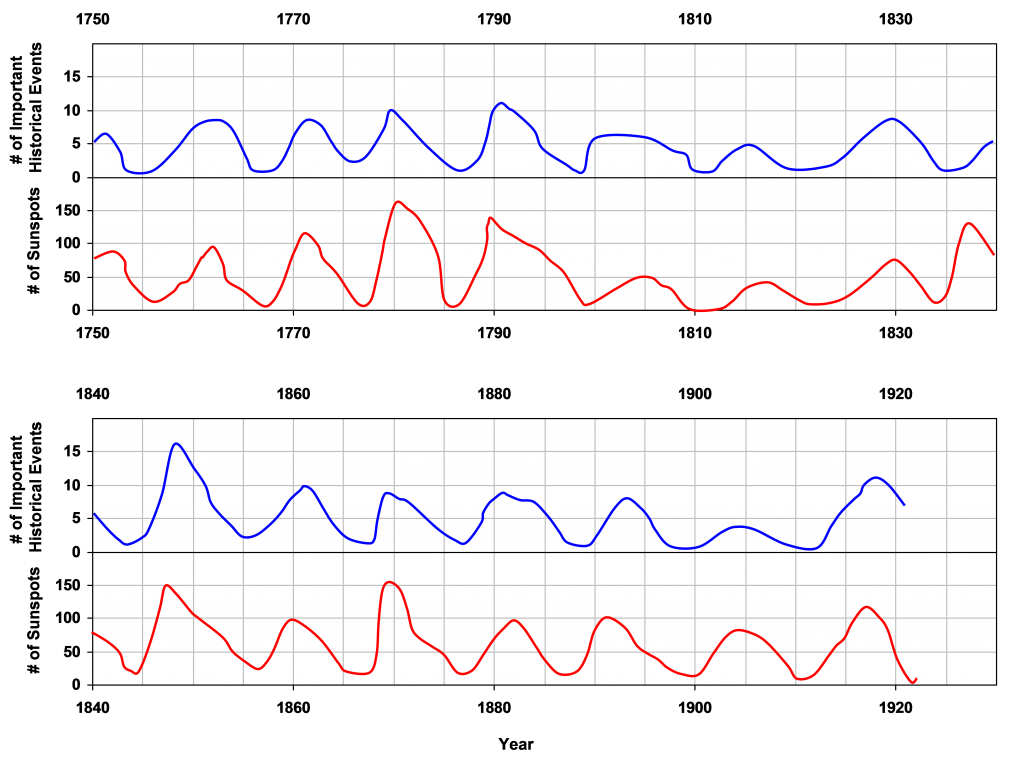

Global Coherence Research graph Tchijevsky’s original data

Tchijevsky’s original data: The blue line plots the annual number of important political and social events such as the start of wars, social revolutions, etc., while the red line plots solar activity as indicated by the number of sunspots from 1749 to 1922. The histories of 72 countries were compiled, and it was found that 80% of the most significant events occurred during solar maximums, which correlate with the highest periods of geomagnetic activity.


Solar activity has not only been associated with social unrest. It also has been related to the periods of greatest human flourishing, with definitive spurts in architecture, arts and science and positive social change.

We can learn from past mistakes and consciously choose new ways of navigating these great energy influxes to create periods of human flourishing and humanitarian advances. When outdated structures that do not serve humanity collapse, an opportunity opens for them to be replaced with more suitable and sustainable models. Such positive change can affect political, economic, medical and educational systems as well as people’s relationships in their workplaces, homes and communities.


Earth Rhythms

Earth has a strong internal magnetic field that appears to be generated by electrical currents in the liquid outer iron core that are driven by internal heat sources. The magnetic field resembles that of a bar magnet or “dipole field” with an axis tilted about 11.5 degrees from the spin axis, so, the magnetic poles are not the same as the geographic poles. Earth’s magnetic field strength was first measured by Carl Friedrich Gauss in 1835 and has been measured repeatedly since then. The field has shown a relative decay of about 10% over the last 150 years. The locations of the magnetic poles are not static; they wander as much as 55 kilometers every year.

The geomagnetic field is influenced by the sun and moon’s rotations, solar flares and probably interplanetary influences. Animals, including birds, can detect Earth’s magnetic field and use it to navigate during migration. It has been shown, for example, that cows and deer, when grazing, tend to align their bodies north-south in response to the earth’s magnetic field.
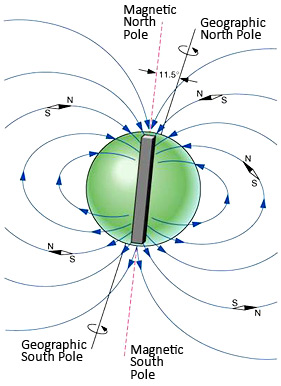
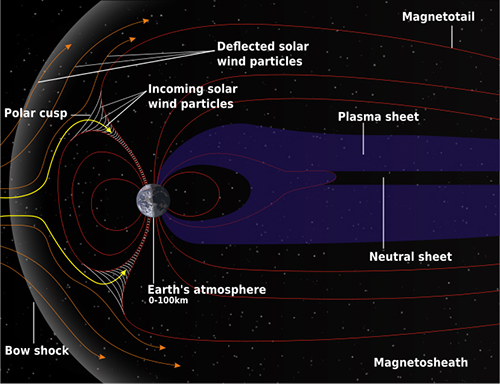
Global Coherence Research earth’s magnetic field


The forces of the solar wind include charged particles that push against Earth’s magnetic field. Because of the solar wind, the portion of the geomagnetic field facing the sun is pushed in toward the earth’s surface and flattened when the portion of the field facing away from the sun, known as the magnetotail, is pulled away from Earth. (See figure below.) A visible phenomenon of the collision of charged solar particles with Earth’s magnetic field is auroras, or the northern and southern polar lights, which are commonly known as the aurora borealis and aurora australis.


Global Coherence Research Magnetotail


When the solar wind meets the earth’s magnetic field it causes various types of complex oscillations in the field that often are referred to as micropulsations and field line resonances. Based on their waveforms, magnetic pulsations and field line resonances have been classified as pulsations that are continuous (Pc) and pulsations that irregular (Pi). Because their frequencies are so low, they are usually characterized by their period of oscillation rather than frequency.

There are a variety of mechanisms that produce these oscillations, such as interactions of solar wind and the earth’s main magnetic field lines; sudden solar wind pressure changes that move/push the field in or allow it to expand out; and sudden changes in solar wind direction that cause the magnetotail to stretch and snap back. The figure below shows an example of these field line resonances, recorded at the GCI magnetometer site in Boulder Creek, Calif. Important note: The frequencies of these field line resonances are in the same range as many of the rhythms found in human and animal cardiovascular and autonomic nervous-system functions.

In the Boulder Creek site example, there is a clear frequency at 0.1 hertz, which is the same frequency as the heart rhythm of someone who is in a heart-coherent state. Research has shown that changes in these ultralow frequencies (ULF’s, also called Pc and Pi), caused by solar activity and changes in geomagnetic activity can affect human health and behavior.
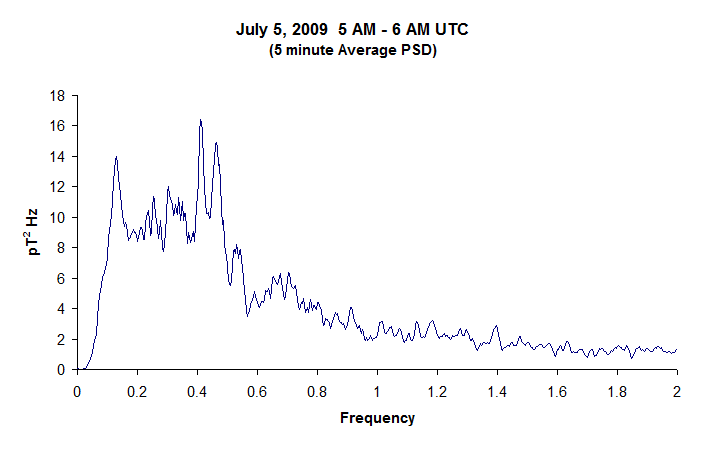

Geomagnetic field line resonance data recorded from the GCI sensor site in Boulder Creek, Calif.


Geomagnetic field line resonance data recorded from the GCI sensor site in Boulder Creek, Calif. Note that all the resonant frequencies overlap human autonomic and cardiovascular system frequencies. In this example, there is a clear standing wave frequency at 0.1 hertz, which is the same frequency of our heart rhythms when we are in a coherent state.


Schumann Resonances:


Schumann resonances are global electromagnetic resonances in the cavity formed between the earth’s surface and the ionosphere. Schumann resonances were named after German physicist Winfried Schumann, who first predicted them in 1952. Electromagnetic impulses like those from global lightning flashes (Earth’s thunderstorm activity) fill this cavity and excite the Schumann resonances. The first accurate measurements of the Schumann resonances were made from 1960 to 1963 and since then there has been an increasing interest in them across a wide variety of fields.

Radiation from the sun ionizes part of the earth’s upper atmosphere and forms a conductive plasma layer, the ionosphere. The ionosphere surrounding our planet is negatively charged relative to the earth’s surface, which creates a strong electrical field between the earth and ionosphere. Schumann resonances occur because the space between the surface of the earth and the conductive ionosphere acts as a closed waveguide. This waveguide acts as a resonant cavity for electromagnetic waves. Schumann resonances appear as distinct peaks at extremely low frequencies starting around 7.8 hertz, which is considered the fundamental frequency.
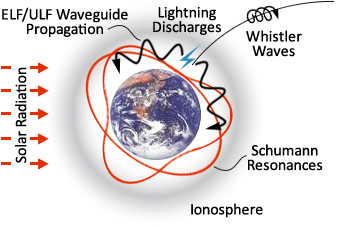


Global Coherence Research Schumann resonances in earth ionosphere cavity 
 Schumann resonances in Earth-ionosphere cavity. Courtesy  NASA.


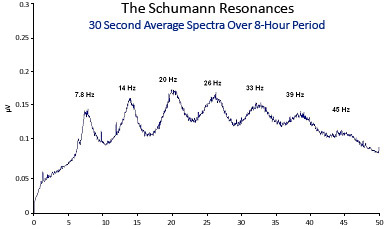
Resonances can be observed at around 7.8, 14, 20, 26, 33, 39 and 45 hertz, with a daily variation of about ± 0.5 hertz, which is caused by the daily increase and decrease in the ionization of the ionosphere due to UV radiation from the sun (also see the live data).

Global Coherence Research GCMS Boulder Creek magnetometers


The signals recorded from the GCMS Boulder Creek magnetometers are converted to the frequency domain with the Fourier transform. The Schumann resonances occurring over an eight-hour period can be clearly seen at approximately 7.8, 14, 20, 26, 33, 39, and 45 hertz.

Interest in the Schumann resonances has gone beyond the boundaries of geophysics, into medicine, where it has posed questions about the interactions between planetary rhythms and human health and behavior (for more detail see the July 7, 2009 Commentary)

The similarity of the 7.8-hertz Earth resonance and human brainwave rhythms was quickly identified after the Schumann resonances were first measured, and early studies were able to demonstrate a correlation between these resonances and brain rhythms. Numerous studies conducted by the Halberg Chronobiology Center at the University of Minnesota along with other studies have since shown that there are important links between solar, Schumann and geomagnetic field line resonances and a wide range of human and animal health and wellness indicators.

Although the existence of the Schumann resonances is an established scientific fact, how these important planetary electromagnetic standing waves act as a background frequency that can influence biological systems such as the heart and brain is not completely understood.
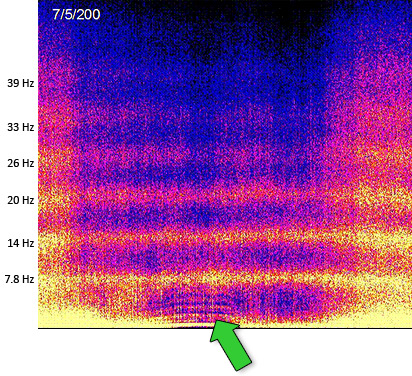

Global Coherence Research continuous pulsations GCMS B.C. CA


The green arrow in this spectrogram indicates continuous pulsations as well as the Schumann resonances. The data was collected by the magnetometer at GCI’s Boulder Creek Calif., headquarters.

Want to listen to the earth’s resonances? This three-minute audio file  is data collected from GCI’s magnetic sensor in Boulder Creek. The resonances have been shifted up in frequency to an audible range. They were recorded at nighttime during a period of relatively quiet ionospheric activity.

GCI hypothesizes that changes in the earth and ionosphere’s resonant frequencies can influence the function of the human autonomic nervous system and brain and cardiovascular systems. Until recently, it has not been feasible to test this hypothesis scientifically. This is because there is a lack of reliable, continuous measures of ionospheric and field line resonances data and an inability to do long-term monitoring of people’s physiological systems such as heart rate variability monitoring, which reflects autonomic nervous-system activity.


Interconnectivity of all Living Systems Through Earth’s Magnetic Field

As noted elsewhere in this article, researchers at the HeartMath Institute and GCI strongly suspect human health and behavior are influenced by solar and geomagnetic activity. In addition, GCI researchers hypothesize that the earth’s magnetic field is a carrier of biologically relevant information that connects all living systems.

Related to this, we have shown in laboratory research that the electromagnetic field generated by the heart of a person can be detected by nearby animals or the nervous systems of other people.

For example, research conducted in HMI’s laboratory has confirmed the hypothesis that when an individual is in a state of heart coherence, the heart radiates a more coherent electromagnetic signal into the environment. This research further has shown that when we are in this coherent state, we are more sensitive to detecting the information in the fields radiated by others. The Energetic Heart: Bioelectromagnetic Interactions Within and Between People Scientific Monograph by Rollin McCraty, Ph.D. . Of all the organs, the heart generates the largest rhythmic electromagnetic field, one that is approximately 100 times stronger than the brain’s field. The heart’s field can be detected several feet from the body with sensitive magnetometers.

The heart’s magnetic field would be a plausible explanation for why we can “feel” or sense another person’s presence and emotional state independent of body language or other factors. HeartMath also has found that there is a direct relationship between the heart-rhythm patterns and the spectral information encoded in the frequency spectra of the magnetic field radiated by the heart. Thus, we believe, information about a person’s emotional state is encoded in the heart’s magnetic field, which is communicated throughout the body and into the external environment.

A growing body of evidence suggests that an energetic field is formed among individuals in groups through which communication among all the group members occurs simultaneously. In other words, there is an actual “group field” that connects all the members. Coherence: Bridging Personal, Social and Global Health paper.

One study demonstrated the effect of heart coherence in a group setting where people trained in maintaining states of heart coherence for several minutes could promote coherent states in untrained participants.

Also supporting the hypothesis that magnetic fields are carriers of biologically relevant information is a recent study that demonstrated epigenetic information related to DNA could be detected as electromagnetic signals in a highly diluted solution and this information can be transferred to and imprinted in pure water that has never been exposed to DNA, but only in the presence of a 7.8-hertz weak magnetic field. Furthermore, this information can lead to the re-creation of DNA when the appropriate basic constituents of DNA are present – but again, only if extremely low electromagnetic frequency fields of 7.8 hertz are present to carry the information.

The study’s authors also state that such a very low electromagnetic frequency field that stimulates DNA information transfer could come from natural sources such as Schuman resonances, which start at a frequency of 7.83 hertz.

Dr. Michael Persinger, a well-known neuroscientist, has conducted numerous studies examining the effects of magnetic fields with the same magnitude as the geomagnetic field on brain functions and information transfer. Not only has he shown that applying external fields similar to the Schuman resonances can induce altered states of consciousness, he also has suggested in a detailed theory that the space occupied by the geomagnetic field can store information related to brain activity and that this information can be accessed by all human brains.

Furthermore, Persinger also suggests that the earth’s magnetic field can act as a carrier of information between individuals and that information, rather than the intensity of the signal carrying it, is important for interaction with neural networks. The above findings help support part of GCI’s hypothesis that the earth’s magnetic field is a carrier of biologically relevant information.

HeartMath and GCI further submit that because humans have brain and heart frequencies overlapping the earth’s magnetic field resonances, they not only are receivers of biologically relevant information, but they also essentially create a feedback look with the earth’s magnetic field and thus feed information into the global field environment.

While it is not difficult to conceive that life forms existing within the earth’s magnetic field could be affected by modulations in this field, it is a more far-reaching proposition to suggest that the earth’s field connects all living systems and carries and distributes biologically relevant information. Nevertheless, GCI researchers hypothesize that when large numbers of humans respond to a global event with common emotional feeling, the collective response can affect the information distributed in the earth’s field. In cases where the event evokes negative responses, this can be thought of as a planetary stress wave (of information), and in cases where a positive wave is created, it could create a global coherence wave.


For more information about the electrogaiagram network see http://nexusilluminati.blogspot.com/search/label/electrogaiagrams  
- Scroll down through ‘Older Posts’ at the end of each section


Hope you like this not for profit site -
It takes hours of work every day by a genuinely incapacitated invalid to maintain, write, edit, research, illustrate and publish this website from a tiny cabin in a remote forest
Like what we do? Please give anything you can -  
Contribute any amount and receive at least one New Illuminati eBook!
(You can use a card securely if you don’t use Paypal)
Please click below -


Spare Bitcoin change?


For further enlightening information enter a word or phrase into the random synchronistic search box @ the top left of http://nexusilluminati.blogspot.com


And see


 New Illuminati on Facebook - https://www.facebook.com/the.new.illuminati

New Illuminati Youtube Channel -  https://www.youtube.com/user/newilluminati/playlists

New Illuminati’s OWN Youtube Videos -  
New Illuminati on Google+ @ For New Illuminati posts - https://plus.google.com/u/0/+RamAyana0/posts

New Illuminati on Twitter @ www.twitter.com/new_illuminati


New Illuminations –Art(icles) by R. Ayana @ http://newilluminations.blogspot.com

The Her(m)etic Hermit - http://hermetic.blog.com


DISGRUNTLED SITE ADMINS PLEASE NOTE –
We provide a live link to your original material on your site (and links via social networking services) - which raises your ranking on search engines and helps spread your info further!

This site is published under Creative Commons (Attribution) CopyRIGHT (unless an individual article or other item is declared otherwise by the copyright holder). Reproduction for non-profit use is permitted & encouraged - if you give attribution to the work & author and include all links in the original (along with this or a similar notice).

Feel free to make non-commercial hard (printed) or software copies or mirror sites - you never know how long something will stay glued to the web – but remember attribution!

If you like what you see, please send a donation (no amount is too small or too large) or leave a comment – and thanks for reading this far…

Live long and prosper! Together we can create the best of all possible worlds…


From the New Illuminati – http://nexusilluminati.blogspot.com


Monday, 15 August 2011

“God Helmet” Inventor Discovers Telepathy Link in Lab Experiments

“God Helmet” Inventor Discovers Telepathy Link in Lab Experiments

Neuroscience Researcher and Laurentian University professor Dr. Michael Persinger demonstrates telepathy under laboratory conditions.

https://blogger.googleusercontent.com/img/b/R29vZ2xl/AVvXsEjgUWjIyX-JSQuvq0qj4pkOYOAmc03Qt76lnAGfs1ubRwmw_3tQRGuXrb_rBSQWY0xBlaSvoThJn2UVP6IDq6Sx5NIg7AmceVxJQdJ7ONGZqcaKwlzYrV597xoqF9TciiY3pG48m3tnCgDq/s400/2362241755_c304b38f8b_b%5B1%5D.jpg

Claims of telepathy, ESP and other psi phenomena are a mainstay of popular culture but taboo in neuroscience research circles.  Fortunately, Dr. Michael Persinger of Canada’s Laurentian University has never been afraid to venture where other researchers fear to go. In the 1980s Persinger made headlines with his “God Helmet”, a device that stimulates temporal lobes with a weak magnetic field in order to produce religious states.

Now, Persinger has discovered the same type of brain stimulation can create metal states conducive to human telepathy.  “What we have found is that if you place two different people at a distance and put a circular magnetic field around both, and you make sure they are connected to the same computer so they get the same stimulation, then if you flash a light in one person’s eye the person in the other room receiving just the magnetic field will show changes in their brain as if they saw the flash of light. We think that’s tremendous because it may be the first macro demonstration of a quantum connection, or so-called quantum entanglement. If true, then there’s another way of potential communication that may have physical applications, for example, in space travel.”

While Persinger’s experiments could prove groundbreaking, he remains doubtful about his controversial findings reaching his colleagues, “I think the critical thing about science is to be open-minded. It’s really important to realize that the true subject matter of science is the pursuit of the unknown. Sadly scientists have become extraordinarily group-oriented. Our most typical critics are not are mystic believer types.  They are scientists who have a narrow vision of what the world is like.”

Play it:


Alex Tsakiris: Welcome to Skeptiko where we explore controversial science with leading researchers, thinkers, and their critics. I’m your host, Alex Tsakiris, and before we get started with today’s interview, and a very fascinating interview it is with Dr. Michael Persinger, I’m going to take a minute and invite you to connect – connect with this show, Skeptiko, and with me personally.

In the last few months as I had a chance to talk to more and more researchers and dig into all the science surrounding human consciousness and spirituality and where science is leading us, I felt a stronger and stronger need to connect with you and to create a community, if you will, of like-minded people. So in the last week or so I’ve tried to take some steps in that direction.

I’ve finally gotten on Facebook and Twitter and I’m going to try and post there more regularly. But I’m going to invite you to join me. To follow me and to allow me to follow you and see if we can create a community, if you will, of like-minded people who are interested in following the data wherever it leads, as I say. So you’ll find all the links on the Skeptiko Web site for following me and please connect up and I’ll do the same.

But for right now, let’s move into this interview that I have with Dr. Michael Persinger.  And quite a fascinating interview it is. I really, really admire the courage that the maverick scientist has, and that’s where Dr. Michael Persinger is. You know, he gets it from both sides. He really is a materialist and very much a mind equals brain guy.

That’s not where I see the data leading but it’s certainly where he sees the data leading, and he really approaches it from a “let’s get down and prove it, here’s the research.” He doesn’t shy away from that. He doesn’t throw extraordinary claims, extraordinary proof kind of bullcrap. He just says, “Hey, here’s what I’m finding, here’s what I think, here’s the way I think things are showing themselves.” I find that very refreshing.

But he also gets it on the other side because while he is very much of a materialist and a neuroscience guy, he also has some surprising data when it comes to telepathy, that you’ll hear about, where he says he’s basically proven it in his lab and can replicate this quantum entanglement communication thing that you’ve heard about maybe on this show and certainly a lot of other places. So very, very interesting. In my mind it’s what makes Skeptiko so exciting for me and makes it hopefully interesting for you to be able to hear from these researchers who we really, really don’t hear enough from. So stay with me for Michael Persinger.

I’m joined today by Dr. Michael Persinger, an internationally renowned cognizant neuroscience researcher and professor at Laurentian University in Canada. He’s probably most famous, and many of you I’m sure have seen him on TV or especially in a YouTube video with his God Helmet, a device that he has used experimentally to demonstrate that electromagnetic disturbances in the brain maybe the source of mystical and spiritual experiences. So, Dr. Persinger, thank you very much for joining me today on Skeptkio.

Dr. Michael Persinger: You’re quite welcome.

Alex Tsakiris: And let me start by as I kind of stuttered through that introduction, is there anything that I may be didn’t quite get right there in describing, I guess, the research that most people associate with you, and that is with the God Helmet and the electromagnetic stimulation of the brain to create mystical experiences.

Dr. Michael Persinger: No, that was very succinctly stated. I mean, effectively what we’ve been doing all these years is to try to understand the brain basis to all experiences. The basic assumption is that all experiences are generated by brain activity, determined in large part by the structure of the brain.

Alex Tsakiris: That point that you just made, is you started with the idea, the materialistic notion that all conscious experience originates with the brain. I think what’s fascinating, if we’re going to dive right into this and make the most effective use of your time, is what do you think about some of the research that seems to be pointing in a different direction?

We could look at the research of folks who have just concentrated on the spiritual experience like a colleague of yours in Canada, Dr. Mario Beauregard or we could look at Dr. Andrew Newberg, or Davidson at the University of Wisconsin, who have all looked at various kinds of spiritual experience and maybe seem to be leaning towards another direction. And that’s that perhaps the neurocorrelates that we see firing one that they may not just be in the right temporal lobes but also that they may point to a kind of different nature of consciousness. I know that’s a lot to kind of bite off, but I’m sure this is stuff that you think about, talk about, and write about all the time. So just jump right in.

Dr. Michael Persinger: Our research starts on the basic premise that all experience is generated by brain activity. Now, the critical thing is that all experience means your experience of love, or memories, or having a mystical experience, must be associated with specific patterns of brain activity. That brain activity in large part is determined by the brain structure. Many of these things, because structure dictates function, may be relatively unique to the human being itself.

Now, although that’s our assumption, the most powerful tool of science is the experiment. So if we want to understand these experiences and how they are generated by brain activity, we have to reproduce them in the laboratory. So the basic approach then was, okay, if people have mystical experiences and they’re associated with brain activity then if we imitate them in the laboratory and we understand the physical conditions that produce them, we should be able to 1) understand the areas of the brain and the patterns of activity responsible for these experiences, and 2) we should be able to control them.

And if they’re a natural phenomena, and we think that mystical experiences, including the God experience, the God belief, are natural phenomena, we should be able to reproduce them easily if we have the correct parameters in the laboratory, control them and understand how they may be manipulated by others with less honorable goals.

http://www.darksidecollective.org/graphics/GodHelmet1.jpg

Alex Tsakiris: Here’s what intrigues me. You’ve really pioneered this work and I think you have some very interesting comments that I’ve seen in previous interviews about what it’s been like to be a pioneer, the old adage of  you know, the pioneer cause he has arrows not just in the front but in the back as well. And I think you’ve experienced a little bit of that just in terms of delving into an area that touches on so many hot buttons on both sides, either believers or non-believers.

Maybe you’d like to comment about that. But in particular, comment about that within the framework of where some of the research into what’s being called “neurotheology” is going. I threw out the spiritual brain, Mario Beauregard, Andrew Newberg at the University of Pennsylvania, Davidson at Wisconsin, you know, folks who are also looking at the spiritual experience and maybe coming to a slightly different conclusion than you are about the relationship between the brain and the neurocorrelates and that spiritual experience.

Dr. Michael Persinger: Well, in terms of trying to understand the neural basis to these powerful experiences that determine the history of human behavior, I mean, don’t forget more people have been killed in wars under the auspices of who’s god is correct, either directly or indirectly than most plagues. So this is a powerful phenomena that may be intrinsic to the nature of the human brain. It may have had a adaptive function over the years. For example, we know that people who believe in God and have God experiences have reduced death anxiety, which may allow them to be more productive.

The whole concept of the immortality is implicitly tied to this experience and the belief in immortality actually reduces anxiety about death and sometimes can make individuals more adaptive to their environment. But ultimately, all of this has to be related to the brain function and there may be different approaches. For example, some of my colleagues have said that there is a non-physical component that’s very difficult to understand because in the history of science those phenomena which were considered to be non-physical ultimately we did find a physical basis. And that when we found the physical basis then we understood it.

If you talk about a phenomena as being sort of ephemeral and non-testable and something beyond measurement, then effectively it’s an empty hypothesis and you never will be able to test it.

To answer your question about people’s approaches, I think it’s really important to have a versatile approach and have people have different ideas, have open ideas, but ultimately the end point must be measurement and reproduction in the laboratory. For example, some of the stuff by Beauregard with the MRI studies, what he really did was look at memories. He asked the people to remember their experiences and found patterns of activity that were basically typical of a memory.

That’s quite different than direct stimulation of the brain and producing the experience, so although we can have different approaches, and I think that’s really important for science to be open-minded and to basically exclude no one. The ultimate measure is going to be 1) can you reproduce it in the laboratory and 2) can you actually product the same phenomena by experimental techniques? And that’s the powerful tool to demonstrate you have a causal connection.

Alex Tsakiris: Right, and we can jump into that causal connection because there’s a couple of points. Let me back up. I’m not as totally familiar with Beauregard’s work although I did remember that he did FMRIs while these nuns were in this peak spiritual state, so I think he did have that…

Dr. Michael Persinger: Actually they were remembering the peak spiritual stage.

Alex Tsakiris: Okay, well Newberg certainly did at the University of Pennsylvania…

Dr. Michael Persinger: Newberg did. And Newberg found completely different patterns which were really similar to what we find when we measure the electroencephalographic activity of individuals having mystical experiences and basically is the same area that we focus upon when we stimulate it with the weak electromagnetic fields generated by the God Helmet. So again, the critical thing is the instructions you give to your subjects in large part will influence different patterns of the brain and that’s why that precision is so important in understanding the neural basis to the God experience.

http://www.wormholeriders.com/blog/wp-content/uploads/Dominica10.jpg

Alex Tsakiris: You know, let’s move into I think probably the most challenging research given what you’ve just said, and that’s the research that’s been done in near-death experience. We can point to just a whole bunch of people, but Peter Fenwick is someone who’s been on the show and Raymond Moody, of course, has been on the show, although I don’t think he’s as active in the field.

What do you make of the rather substantial amount of evidence that has come back that suggests that in some way that we don’t totally understand, there is this continuation of consciousness after a period when there is no EEG and no EKG for a number of patients that have been verified clinically  in a hospital setting by the people we normally trust to kind of gather that kind of information.

Dr. Michael Persinger: Well, first of all, the electroencephalogram or brain waves simply measures a very, very small component. It’s in the microvolt range. It’s about a thousandth times smaller than the actual steady state potential of the brain itself which can last for several minutes to half an hour under sort of deprived conditions. The EEG also reflects only the cortex. It doesn’t tell you very much at all what’s going on deep within the cortex. So when you have these near-death experiences and flat EEGs, that just tells you what the cortex is doing. It doesn’t tell you necessarily the integrity or the activity taking place deep within the brain.

Alex Tsakiris: Right, but…

Dr. Michael Persinger: The second feature…

Alex Tsakiris: Go ahead. I was just going to say, I was just going to interject here. But I’ve heard that argument before from materialists and I just – I don’t get it. I mean, at this point we have tens and tens of thousands of EEGs and we know how your EEG is supposed to look when you’ve having the kind of experience that these people describe. And it certainly never looks flat. I mean, we don’t have any record of that in any that I’m aware of, where anyone has done an EEG of a live person and say, oh, it’s flat and then they say yeah, but I had this incredible experience. How do you kind of connect those two?

Dr. Michael Persinger: Well I certainly can. And I think the reason is we’re looking at the fact that out of body experiences, which is what you’re talking about in near-death experiences in large part, the idea that you’re detached from your body and you’re somewhere else. It is not due to a homogeneous source. For example,  a near-death experience after a flat EEG is quite different, for example, when someone is wide awake or in an altered state and experiencing an out of body experience. In that case, the activity is very, very clear and very, very systematic. You usually get certain kinds of alphoid activity which is in the order of a low frequency over the right parietal region.

Mind you, the same thing can be done by stimulating, as reported in Nature a few years ago. The right parietal region, you can actually get a feeling of being detached or being somewhere else. The so-called mental bipolaria of being two places at once. So when people are awake and the experience takes place that’s quite different than when people have been in a medical situation where they’re considered to be dead and then the EEG returns to normal and they report what they think they’ve experienced.

Alex Tsakiris: I’m still not getting that. I mean, my understanding is that all our understanding of this tool we have, called an EEG, suggests that this other kind of very ephemeral thing that we’re trying to get our arms around called consciousness, that there’s some correlation between the way we measure the two. And I just can’t accept the idea unless maybe you can point me to the research where I can find that. Where people are saying, “yes, you can have this complex conscious experience and we would not be able to measure it with an EEG.” I just don’t see where anyone has demonstrated…

Dr. Michael Persinger: Well, I agree with you, I agree with you. Yeah, I agree with you totally. If there’s an experience there’s going to be brain activity. And if you can articulate the experience, that is, at the time the person’s having the experience, measure the EEG, particularly quantitative EEG, there are very specific patterns over very specific regions of the brain that relate to that kind of experience. That’s well known in the quantity EEG literature. So when someone says, “I have an experience, ” be it mystical or whatever, you can actually measure the brain, which we’ve done on many occasions and see very specific signatures taking place.

Even with those that are so-called psychic experiences we tested Shawn Haribands, who is a very reliable individual for sort of guessing and feeling people’s memories. When he’s doing that, there’s very specific patterns that take place over his right parietal temporal lobe. The number of those that take place is directly related to how accurate he is in how many of these statements he makes. So you can relate quantitative EEG or brain activity to very specific experiences.

Alex Tsakiris: I mean, I think that’s a whole fascinating area and I’d love to kind of jump in there, but I don’t want to quite yet leave this near-death experience because I want to understand fully what you’re saying. So my understanding in reading the near-death experience research is we have some pretty – a handful, dozens, on the order of dozens or maybe a hundred, of very well documented cases where we do have EEG and EKG records of folks who have had cardiac arrests and during that whole process, then we’re also able to verify that they had some kind of experience when they were resuscitated and they have some kind of conscious experience that seems to correlate time wise to the time when we had no EEG from them, so I’m just wondering what you make of that.

Dr. Michael Persinger: Well, like I’ve said, if you’re talking about having out of body experiences in a waking person, there are very specific patterns over the right parietal temporal lobe that are measured reliably. This has been known for at least 30 or 40 years. Now, the near-death experiences which are also out of body experiences but usually occur in specific settings, for example, like in a hospital or fatigue or following a crisis or a trauma, yes EEG can change remarkably and sometimes be flat-lined for a protracted period. When the person wakes up and the EEG becomes normal, they report these interesting experiences.

Those experiences in large part reflect the areas of the brain that were activated during that time and many of the patterns of near-death experiences are very specific, very reliable. That’s why they show up across all humans in all cultures, of changes within the vasculature, that is the blood vessel activity or blood flow, in the areas that are most vulnerable. That’s why first you get the tunnel effect and the moving through the tunnel and then of course the out of body detachment. Then you may get memories and you may have the invariably the sense of presence of a deceased entity or a cultural icon, for example, it could be a religious icon. These are very predictable patterns if you know the part of the brain that is slowly becoming over-active because it’s in a failure state.

Alex Tsakiris: But wait a minute. I’m still not making the connection. No EEG, conscious experience. How can that be?

Dr. Michael Persinger: Well, first of all, during the flat EEG, okay the person’s not saying anything. They’re in a state that’s not – they’re making not any state. When they come out of the flat EEG and they begin to talk, they talk about experiences. Now it’s important to realize that the EEG is measuring only the cortex, which is the outer 2-3, 3-5 millimeters of the brain. It’s a tool that’s only measuring 1,000 potentials, all those fluctuations, but when you flat-line, there’s still tremendous potential. The DC potentials are there. It’s like a pool. If you have a pool that’s 100 meters deep and only the top one meter is fluctuating, if you flatten out the fluctuating and make it nice and flat, that doesn’t mean that the 100 meters has gone away. It’s just not moving anymore.

And so the measurement will look like it’s flat, but there’s still potential difference. That’s a very important technical aspect of EEG work that most people don’t realize.

The second feature is that the electrical ability or electrical storage of memory is about 30 minutes. So every – right now as you and I are chatting, our brains are going to store this information in electrical form for about 30 minutes before it’s ultimately transformed into the small microstructures, the synapses that allow us long-term memory.

Now that information is being stored deep within the brain. It’s not in the cortex at all and you can’t even see it from an EEG. For example, the areas of the brain we call the hippocampus that store memory, you can’t even see the activity from a EEG. You have to actually put electrodes deep into the brain in order to see that activity. So there’s a common misconception that a flat EEG means no brain activity. In actual fact, it simply tells you a kind of activity is no longer common.

Alex Tsakiris: So that’s interesting. So you would speculate that that’s what’s happening in these near-death experiences, at least the ones that we can verify where there is no EEG measurable. You suspect that there is the same kind of conscious experience that they report going on but it’s at some level deep inside the brain that we just can’t measure. Is that correct?

Dr. Michael Persinger: Well, that would be very close. In fact, when the person wakes up after 20 or 30 minutes or at some particular protracted time, what they’re doing is telling you what they experienced. So they’re not necessarily conscious at the time. They’re reporting experiences that they’ve had. And I think that’s a very important distinction that deep within the brain that information is being consolidated and so if you suddenly become active again, then you can have access to the information. Very much like during a good portion of the night you’re not dreaming.

There’s all kinds of activity going on within your brain. All kinds of metabolic activity and information being represented. During the dreaming state you suddenly have access to it and if you wake up you can actually remember it, even though it may have been going on for several minutes to tens of minutes. You now are aware of it and you can now report it. So it’s like suddenly becoming on-line, so to speak, in terms of a computer. The information’s been there for quite a while. Now you can talk about it and remember what happened.

Alex Tsakiris: Interesting. What do you make of the reports of people retrieving information that they wouldn’t normally know? Being able to say, “Yes, I recall that you were the one who resuscitated me.” Dr. Penny Satori has actually done some research of the ability of people who’ve recovered from cardiac arrest, those who have experienced a near-death experience are better able to recollect, if you will, I don’t know if that would be the correct term – the actual procedures that happened during the resuscitation.

Then a control group who were resuscitated but didn’t have a near-death experience. What do you make of the fact that people routinely in these near-death experience accounts say, “I was able to travel. I was able to see inside the room. I was able to travel home and see what Mom was cooking for dinner. Or see what was going on in these other places.” What do you make of that?

Dr. Michael Persinger: I think those are very interesting experiences and I think the critical thing is the information may be very accurate but the explanation and the perception the person has may not. For example, most of us would agree that the sun rises in the east and sets in the west. If you’re in Ptolemies’ day, the perception would be it’s because the sun is moving around us. That’s the perception. Now, of course, we realize that’s not the case. It’s because the Earth rotates. The sun is not going around us. But the perception is similar, so the interpretation will change.

And the same thing happens with these near-death experiences in the sense that yes, information may be obtained but that of course is then filtered through how the brain interprets information. For example, right now if you’re looking at someone nearby, you see an integrated image. But in actual fact, from the time that the retina picked up that image, all the parts of that image were broken apart into more than 3, 4, a dozen different kinds of components. What the color was, how the person was moving, their facial characteristics, goes to different parts of the brain and then is re-integrated according to how the brain is organized and your expectations.

So in large part, memory is a reconstruction of the experiences. So the same thing happens here. The information may be there but how you interpret it and report it is going to be a function of how your brain is organized, your belief system, and how you accommodate language and information.

http://technoccult.net/wp-content/uploads/2010/03/cosmic_eye.jpg

Alex Tsakiris: I’m not sure I totally got that. So how would someone know something that was happening at a distance? Happening far away, three floors above them in the hospital where they saw something?

Dr. Michael Persinger: Oh, okay, now in terms of looking at something that’s a distance away, again, information is around us all the time and we’re typically not aware of it. Let’s first of all address that first comment about how can people be aware of things when they’re under anesthesia? Well, first of all, for over 30 years we’ve known that if you’re sleeping and deep sleep, and we whisper your name in your ear, your EEG will show a response or evoke potential, will show response even though you’re never aware of it. So the brain never really goes away, even though it may be in a state of anesthesia.

The second feature: if it wasn’t for the fact that it’s a near-death experience and is exotic, it wouldn’t be as impressive because if you look at the functional MRI of a brain of a person reading and you suddenly change the text, very subtly, there are areas of the brain that are activated even though the person is not aware of what’s going on. In other words, the brain responds even though there’s no awareness associated with it.

And in another example, so-called psychic blindness, these are individuals who are blind but yet as they are walking about they can move around objects and if you look at their brains you find that a small amount of their occipital cortex is activated enough for the unconscious reflex systems to respond and move around the objects, but not enough critical mass for them to say, “I’m aware of what I see.” So the critical thing is you can have a lot of changes and detect a lot of changes in your environment without necessarily awareness.

Now to address the issue of things at a distance, that of course, is totally acceptable and expected. Right now you and I are being inundated by cosmic rays, by signals from cell phones, from just literally billions of events but we’re only aware of a couple of them or a few of them per unit time that we call stimuli. So what would happen if you changed the organization of the brain and you became aware of events that were taking place at a distance? It could be anything from, for example, picking up radio signals or something equivalent. If you change the structure of the brain, and that’s what happens in altered states, then of course, you can pick up information at a distance.

The classic example would be when you’re dreaming. All right, the environment, stimuli that you’re not even aware of at quite a distance, for example, a sound from a bell or the temperature of the room can be incorporated into your dream content. So what makes the near-death experience so exciting is that – and indeed, altered states in general – is it opens up a more objective way of trying to understand what has been rejected, sadly, so many years, called parapsychological phenomena, which is simply information obtained from a distance or time through mechanisms not known to date. And if you keep the definition that way it becomes much less mystical.

Alex Tsakiris: Wow. You just gave a definition there that I guess you could take in a number of different directions. Now you took it in a kind of very – ordinary is probably the best word – ordinary direction in terms of, hey, maybe you can tune into radio waves or other signals at a distance. But you also seem to leave open the possibility that you could tune into other communication along the lines of the experiment you said you did with the psychic who seems to be able to tune into certain kinds of information at a distance. Any thoughts on that? And I guess that would also tie into…

Dr. Michael Persinger: Oh, absolutely. I mean, I think the critical thing about science – and again, this is how I started at the top of our interview – is it’s really important to be open-minded. It’s really important to realize that the true subject matter of science is the pursuit of the unknown. And sadly scientists have become extraordinarily group-oriented. Our most typical critics are not individuals who are mystic believers. It’s scientists who have a narrow vision of what the world is like. In science we have arbitrarily divided nature into increments we call scientific disciplines into physics and chemistry and psychology and so forth. But in actual fact, this division is quite artificial.

And natural phenomenon – and there’s lots of natural phenomenon to study – really are the subject matter of science and pursuit of the unknown is the subject matter. So that means we have to remain open-minded. The only difference between a scientist and a religious believer or a mystical believer is the fact that we measure. And once we measure it we can reproduce it experimentally. If you can experimentally reproduce it, you can control it. And then you understand how it works. That’s the only difference to science is open-minded. Anything is possible.

Alex Tsakiris: What an interesting way to maybe start to wrap things up. Can you maybe in the last few minutes that we have, tell us some of the most interesting things that are going on in your lab today, and some of your most current discoveries?

Dr. Michael Persinger: Well, what’s going on in the laboratory – and I have some fantastic graduate students and we work together as a team – and what we have found for example, is that if you place two different  brains, two different people at a distance, you put a circular magnetic field around both. There’s a magnetic field going around like a coil, around both brains even at a distance. You make sure both coils are connected to the same computer which means they’re generating the same configuration of two different spaces.

If you flash a light in one person’s eye, even though they’re in a chamber that’s closed up, the person in the other room that’s receiving just the magnetic field now, they’re not aware of the light flashing or not, they will show similar changes in frequency in the room. And we think that’s tremendous because that maybe the first macro demonstration of a quantum connection or so-called quantum entanglement. And if that’s true then there’s another way of potential communication that may have physical application and application, for example, in space travel because there’s no time involved with it. That’s one thing we’re looking at. That’s one of our more exotic hypotheses.

Other ones we’re looking at, for example, how various kinds of patterns of electromagnetic fields generated from the brain may influence cell cultures in terms of influencing their outcome in terms of their molecular chemistry, which may someday add to the understanding of how somebody being nearby can influence the physiology and health of a person. We know about individuals with green thumbs. We know that certain physicians are better than others just by touching the patient. And it’s more than just a placebo effect. What’s the mechanism? We’re trying to understand that.

And the third thing I think is really important is we’re trying to understand the nature of consciousness itself. And of course, consciousness is probably more like an over-inclusive term. It’s probably not consciousness but a variety of complicated processes and we just slam this word on it that are involved with individuals have these unique skills, like the Shawn Haribands and the Ingo Swanns who seem to have access to information that others do not have. So we’re trying to understand the neurophysical basis to it and to try to integrate it in terms of the known energies around us so that someday we can also replicate it. That really is the real test of a hypothesis or an idea. Can you replicate it with an experiment?

Alex Tsakiris: Wow, very fascinating stuff. It does lead me – I can’t resist asking this one more question. If you do seem to be kind of leaning in the direction of saying that there might be other ways that consciousness interacts with other consciousness, you know, the telepathy thing with the light flashing, then are you open to the possibility that maybe the physical structure of our brain is more of a transceiver than the agent that creates consciousness, as some people have suggested. Is that on the table for you, or…

Dr. Michael Persinger: Absolutely. The idea that the brain, of course,  is a source of all experiences because the brain, obviously if you terminate it you don’t have experiences, but the counter hypothesis – actually it’s not even counter, it’s a parallel hypothesis – that the brain is microstructured. This infinitesimal, complex pattern, is microstructured so that it can serve as a substrate for electromagnetic patterns.

And those electromagnetic patterns are the behaviors and the experiences, which means technically they could exist somewhere else. That means that if indeed there is an electromagnetic pattern, a complex one though it may be, associated with consciousness, if you recreated a substructure in another kind of setting, for example, a computer or in rocks or in trees, could you have some simulation of that? That, of course, is a hypothesis that definitely deserves testing.

Alex Tsakiris: What a wild ride you have there in your lab, huh? You must wake up – also in your interview I read how your work ethic is quite impressive. Do you still work until the wee hours of the morning every day?

Dr. Michael Persinger: Yes, we do. We work until about four in the morning.

Alex Tsakiris: Wow. That’s great. Well, we’ll all stay tuned to the exciting and interesting things that are sure to come out of all your work. Thank you, thank you so much for joining us today on Skeptiko, Dr. Persinger.

Dr. Michael Persinger: Well thank you for asking me.

Alex Tsakiris: Thanks again to Dr. Michael Persinger for joining me today on Skeptiko. If you’d like more information about this show, including all those links that I spoke about in terms of connecting up with me and connecting up with this show, please visit our Web site. It’s at skeptiko.com. You’ll find links to all our previous shows. You can also post your comments right there, or you can go to the Skeptiko forum and post your comments there, as well.

That’s going to do it for today. I have some very interesting interviews along this line coming up, so stay with me for that. And until next time, bye for now.

god2

- by Alex Tsakiris


Images - https://blogger.googleusercontent.com/img/b/R29vZ2xl/AVvXsEjgUWjIyX-JSQuvq0qj4pkOYOAmc03Qt76lnAGfs1ubRwmw_3tQRGuXrb_rBSQWY0xBlaSvoThJn2UVP6IDq6Sx5NIg7AmceVxJQdJ7ONGZqcaKwlzYrV597xoqF9TciiY3pG48m3tnCgDq/s400/2362241755_c304b38f8b_b%5B1%5D.jpg
http://www.darksidecollective.org/graphics/GodHelmet1.jpg
http://www.wormholeriders.com/blog/wp-content/uploads/Dominica10.jpg
\http://technoccult.net/wp-content/uploads/2010/03/cosmic_eye.jpg


For further enlightening information enter a word or phrase into the search box @  New Illuminati or click on any label/tag at the bottom of the page @  http://nexusilluminati.blogspot.com

And see

The Her(m)etic Hermit - http://hermetic.blog.com


This material is published under Creative Commons Copyright (unless an individual item is declared otherwise by copyright holder) – reproduction for non-profit use is permitted & encouraged, if you give attribution to the work & author - and please include a (preferably active) link to the original along with this notice. Feel free to make non-commercial hard (printed) or software copies or mirror sites - you never know how long something will stay glued to the web – but remember attribution! If you like what you see, please send a tiny donation or leave a comment – and thanks for reading this far…

From the New Illuminati – http://nexusilluminati.blogspot.com