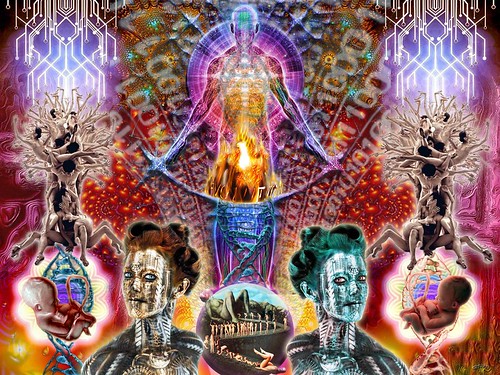
The First People
We are surrounded by evidence of primordial civilisations

by Zakaria
Bziker
“Why should we be so arrogant as to assume
that we’re the first homo-sapiens to walk the earth?”
No one remembers one’s moment of birth and neither does humanity. The beginning of man on earth is a complete mystery. The present article, however, is not about how man came to be, but about shortly after that. It is about the dawn of humanity, a missing chapter in the human history. This chapter is of a forgotten people that mapped the earth and the sky long before there were ancient Egyptians or Jews. These mysterious first people are not to be confused with Australopithecus, Homo Habilis, or Homo Ergaster. They are, instead, the people remembered by ancients as ‘gods’; the people that first engineered societies leaving baffling traces on earth.
The idea of progress is new. Before the enlightenment, human civilizations throughout history viewed the past as being glorious and did not expect the future to be better than the present but to resemble and repeat the past. Man did not think highly of themselves until after Kant declared the motto “Sapere aude” – dare to think for yourself. Since then, our attitudes towards the past changed. But the question remains: what is in our distant past that made the ancients behold it with such impressiveness?
Scientific and technological progress does not have to take thousands of years. The pace of progress could be exponential, slow, or even regressive; exponential through accidental breakthroughs and inventions, e.g. the 20th century, slow when it is impeded by a force majeure such as the Roman church, or the Black Death that prolonged the dark ages for a century, and regressive when undergoing a massive loss of knowledge, e.g. the burning of the Alexandria library in 391 A.D. The idea that scientific and technological development takes millennia is a baseless fact. This idea, if not just an impression, is just our assessment of the known history. Technological progress is inevitable and desirable for any civilization. It could take a couple of centuries to millennia depending on circumstances.
Science and technology change not only the way we live presently but also the way we view both the past and the future. As we go on progressing, our expectations of the future change depending on the breakthroughs we come across and the pace of the scientific development. Similarly, our vision of the past changes too as we gain new ways and means of investigating facts. The current worldview of the past is that things were primitive, and that mankind emerged from a state of barbarism to become smarter and more capable. However, new emerging evidence suggests otherwise.
What started it all was originally Plato’s account of Atlantis. Yet, across the two millennia, his account was considered fictional if not misunderstood. Not until 1882 that the U.S. Congressman Ignatius Loyola Donnelly published his book ‘Atlantis: The Antediluvian World’ in which he gathers all sort of the then-available evidence in favor of an early mighty civilization that was far more advanced than it had any right to be. He mainly studied ancient myths and believed Plato’s account to be historically accurate. Forty-seven years later, a medieval map called Piri Reis was found at the Imperial Palace library in Constantinople (Istanbul) in1929. This map inexplicably depicts the cost of South America and Antarctica with unprecedented fine details corresponding to nowadays longitude and latitude albeit the map dates back to 1513.
It wasn’t until after the Piri Reis map had made its appearance that other maps of high precision started emerging in the following years, eg: The Ribero maps 1520-30, the Ortelius map 1570, and the Wright-Molyneux map 1599 (McIntosh, 2000:59). Upon its discovery, it was thought that the map had been based on Columbus explorations without regard to the fact that Columbus never surveyed South America. Later on, Charles Hapgood studied the map intensively to come up with the conclusion that an advanced civilization in the remote past had existed and had mapped the earth beforehand (Hapgood, 1966). Hapgood’s unorthodox theory of earth crustal displacement also accounts for a preexistent civilized culture in Antarctica. Albert Einstein remarked that Hapgood’s ideas had scientific worth (Einstein, 1953). Years later in 1978, Brad Steiger’s book ‘Worlds Before Our Own’ rekindled the issue. Steiger studied the OPA (Out-of-place artifacts).
The underlying counter-assumption to his findings says that: if humans were primitive in the past, common sense then says that the deeper one digs down into the earth, the more un-advanced artifacts one finds. Steiger found that some advanced human artifacts are located in the lowest primordial geologic strata whereas primitive ones are located in upper strata and thus labeled Out-of-Place Artifacts. He also presented evidence that strongly suggests the cohabitation of dinosaurs and humans. Steiger’s unconventional book fueled other subsequent works such as Dead Men’s Secrets (1986), Forbidden Archaeology (1993), The Orion Mystery (1993), Fingerprints of the Gods (1995), and Technology of the Gods (1999). The book was also met with a great deal of criticism. Nowadays these emerging ideas along with supporting evidence call into question the current worldview of the first people.
Let us now move to the implications of this view. When one subscribes to the current eccentric theory of history, one is then driven to speculate two possible past events that put an end to these people. Either these ancients were so advanced that they destroyed themselves, or they were destroyed by a global cataclysm from which a few survived. The first case seems less probable than the second although there might be some clues that imply ancient warfare.
“When the first atomic bomb exploded in New Mexico, the desert sand turned to fused green glass. This fact, according to the magazine Free World, has given certain archaeologists a turn. They have been digging in the ancient Euphrates Valley and have uncovered a layer of agrarian culture 8,000 years old, and a layer of herdsman culture much older, and a still older caveman culture. Recently, they reached another layer, a layer of fused green glass”
(New York Herald Tribune,
1947)
The assumption of uniformitarianism makes scientists attribute the current features of the earth surface to a slow process that took millions of years. The alternative view however suggests that these features are actually the result of a worldwide cataclysm that took place mere thousands years ago. In this article, 3 pieces of evidence in favor of the cataclysm will be provided.
We have first the problem of carbon dating method. Most geologists use carbon dating to determine the age of fossils and geologic strata. The reliability of this dating method requires a balance between the forming and decaying of radioactive carbon that has been maintaining its equilibrium for millions of years in earth’s atmosphere. However, its forming and decaying has not even yet reached equilibrium on earth for the amount of C14 that is being produced is greater than that which is being decayed. As a result, we cannot use today’s C14 ratio (0.0000765%) in the atmosphere as a benchmark to measure the presence of C14 in ancient fossils. Plus, it is hopeless to correlate earth’s epochs with the geologic column since the latter is based on fiction (Huse, 1983:15; Smith, 2012:242).
Vertical petrified trees are the whistleblower that exposes the invalidity of the geologic column. Many petrified trees running across multiple geological strata have been observed in nature which could only suggest that these strata formed in a short period of time, a result of a rapid cataclysmal sedimentation for example, but not a process of millions of years (Harold 1969;1971, Rupke, N.A, 1970).
Second, there is scientific evidence of a past near-extinction event, also known as population bottleneck event. The two researchers William Amos and J.I. Hoffman from University of Cambridge found genetic evidence for a sudden and drastic decline of the world population to a very small number of people just thousands of years ago (Amos & Hoffman, 2010:131-7). This is speculated to be caused by a worldwide cataclysm.
Third, there are stunning similarities among several ancient myths and legends of different people across the globe on the event of a past global catastrophe, more specifically a global flood similar to the one mentioned in both Biblical and Qur’anic accounts. Some of these myths are Sumerian creation myth (ca. 1600 B.C.), Ancient Greek flood myths, ancient myths of Kwaya, Mbuti, Maasai, Mandin, and Yoruba people in Africa, Yu the Great (ca. 2200 B.C.) and Nüwa in China, Tiddalik in Australia, Hopi mythology in North America, Unu Pachakuti myth of the Incas in South America and this is not the end of the list for there are more than 500 ancient deluge legends (Cox, 1997:198; Dey, 2012: 112; Wohl, 2000:273; LaViolette, 2005: 235). These myths are traces of a global collective memory referring to an actual occurrence in the distant past.
Myths are the fossils of history (Gray, 2004:15). They preserve history in ways that would not make sense to us. The dialogues of Plato regarding Atlantis are but the most vivid memory of antediluvian societies we have nowadays. Some myths do still recall some faint memories of the golden age but these memories are depicted in the guise of magic and supernatural powers. Take the example of the Sanskrit epic of vimanas about a mythological flying machine. Recently, some researchers have immersed themselves into studying ancient myths from this perspective, e.g. Max Igan, 2005, and they have found rather curious results.

How about acknowledging first that the biggest manmade edifices on earth are concrete and unnoticed evidence? For thousands of years, the Great Pyramid of Khufu had been the tallest structure on earth until the Empire State Building skyscraper was completed in 1931, and still is “the most colossal single building ever erected on the planet” (britannica.com). It is aligned to true geodetic North and its location is found to be the center of the earth landmass. This sort of precision entails a comprehensive knowledge of earth geography, e.g. Mercator projection, which is something very unexpected of ancient Egypt (Bauer, 2007:86). In addition to that, engineers and scientists conclude that it is impossible to replicate the great pyramid despite the sophisticated technology we have nowadays given the structure’s immensity and staggering precision (Fix, 1984; West, 1993; Hancock, 1995; Rux, 1996: 265; Dunn, 1998; Amato, 2007:4; Atiya & Lamis, 2007:3; Beaudoin & Joseph, 2007:54; Sheldon, 2009:146-147; Cadose, 2012:75).
“Scientists
have conceded that modern man cannot build a great pyramid that would retain
its shape for thousands of years without sagging under its own weight.”
(Gray,
2004:172)
The engineer Markus Schulte, however, speculates that if it were possible to replicate the Great Pyramid alone, it would nowadays cost us some $35 billion (Malkowski, 2010:117). Investing such money in such colossal structure, that is not even habitable, and without any expected profit, is something we certainly do not do today. So the question of ‘how was it built?’ is of less importance to ‘why was it built?’
One of the latest theories that seems to make sense as to why the Giza pyramids were built is the Orion Correlation theory (1993) advanced by Robert Bauval. The theory suggests that the three pyramids at Giza mirror the three stars in the Orion constellation, also known as Orion’s belt, and the position of the Nile River in relation to the pyramids mirrors the position of the Milky Way galaxy in relation to the Orion constellation. Further, Bauval observes that the shaft within the Great Pyramid was, in the past, oriented towards the middle star of Orion’s belt which is the start representing the same pyramid.
However, that is not all there is to the theory. Bauval’s theory does not make much sense without taking into consideration the astronomical phenomenon called precession of the equinoxes, also called the Great Year or the Platonic Year. This phenomenon is plainly earth’s third cycle after the daily and annual ones. The cycle is either caused by the slow wobbling of the earth due to the moon gravitational pull or by the whole solar system moving in a helical orbit. Its implication is that the night sky stars move backward across the eons. As a result, the position of constellations in the night sky for the ancient is not the same as of their position nowadays. Every time the sun rises in the morning of the vernal equinoxes (March 20th and September 22nd), the background constellation on the horizon of that morning is one of the Zodiac constellations. One cycle is completed when the entire zodiac constellations come to pass. The NASA estimates the cycle to last 25,800 years making each constellation last 2,125 years in the morning of the vernal equinoxes.
How is that information relevant to the Giza plateau? Well, in the immediate vicinity of the pyramids we have the Sphinx which faces East. The Sphinx shape seems to resemble a lion, and thus Bauval suggests that it symbolizes the Zodiac constellation of Leo. In the morning of the equinoxes, the Sphinx in the present era faces the constellation of Pieces and is slightly shifting towards the constellation of Aquarius, but by running a computer backward simulation of earth’s precession, we find that the Sphinx at some point in the remote past used to face the constellation of Leo from 10,970 to 8810 B.C. Now the eureka moment is when we line up the shaft inside the Great pyramid with the middle star of Orion’s belt in that epoch and at last we have an exact date of around 10,450 B.C. So all of a sudden the pyramids are no longer tombs but a gigantic clock that has a date frozen into its structure.
The first scientific recognition of the precession cycle took place in ancient Greece (129 B.C.) by the astronomer Hipparchus. However, long before that ancient Mesopotamia, Maya and Egypt somehow knew about the cycle and we do not know whether this knowledge was handed down from earlier times or they scientifically discovered it. This cycle tracks time on a large span and it is “extremely difficult to observe, and even harder to measure accurately, without sophisticated instrumentation” (Hancock, 1995:231). Using the cycle as an astronomical clock with the help of an eternal structure that defeats the eons of time and all of that with staggering precision is something very remarkable that presupposes a thorough knowledge of astronomy and engineering.
At this point it is even doubtful to think that ancient Egyptians designed and built the Giza Necropolis. We know many aspects of ancient Egyptian daily life with the minutest details. However, there is no single mention of: “Oh, by the way, we also built the pyramids” in their hieroglyphs records or even the existence of any hieroglyph inscription inside the three main pyramids. Some evidence even suggests that the site predates the legendary flood. Incrustations of natural salt were found inside the great pyramid when it was opened for the first time (Dinwiddie, 2001:164). Furthermore, in the 1750’s, the naval captain and explorer Frederic Norden reported the existence of a great number of oysters and seashells in the vicinity of the pyramids and the Sphinx.
In his Histories, Herodotus also reports that he observed in the surrounding area of the pyramids seashells and signs of salt water calcification back then (Herodotus, ca. 450 B.C., Book II:12). All that seems to suggest that maybe the Giza plateau was once underwater. Then what about the strong tie between ancient Egyptians and the Giza plateau? Aside from ancient Egypt, most ancient civilizations exhibit a sort of obsession and admiration for pyramid-like structures which could originally be ascribed to the three pyramids at Giza. Further, the failed attempts to reproduce the pyramids on a small scale, like the case of the three Queen’s Pyramids, explain how impressed ancient Egyptians were with the colossal three edifices. It is not so crazy after all to assume that ancient Egyptians founded their entire civilization in the vicinity of the Giza plateau only to be identified with the immensity of the structures.
If one assumes that the correlation theory is valid, then one has to ask the question: why is the 10th century B.C. an important date for the pyramid builders? Why would these ancients go to such trouble to build huge monuments that hint at a specific date? What was happening back then? In general, 10,000 B.C. is a very significant date in our conventional wisdom. It is the date when the late ice age ended. It marks the first appearance of wooden buildings, human settlements in the Americas and the domestication of animals. Remains of humans in caves and a remarkable transformation marked with the introduction of farming all date back to the same era. All these sudden developments could signify two possible scenarios. The first suggests that humans were witnessing the most significant step in their long chain of evolution. The second suggests humans were actually recovering from a worldwide cataclysm.
Following the line of the second, and less known, scenario, one cannot of course expect survivors of a cataclysm to build cities right from the start. They would have to spread out over the earth which would eventually result in linguistic deviation. Keeping track of one another would not be possible due to the absence of means of communication. The latter may explain the absence of historical accounts before the city of Uruk made its appearance ca. 4500 B.C. So, instead of progressing forward, humans would have to go through a phase of silence characterized by the struggle with nature and the use of archaic tools before they start coming together to build urban centers.
The book ‘Noah to Abram: The Turbulent Years: New Light on Ice Age, Cave Man, Stone Age, the Old Kingdoms’ by Erich A. Von Fange highlights the striking similarities between the knowledge we have about early archaic human cultures of the Lower Paleolithic period (Oldowan, Acheulean and Mousterian tool cultures) and the case of a post-cataclysm man trying to survive upon the ruins of their ancestors. Given the growing body of evidence, the second view is now becoming more recognized in outer circles. The Roland Emmerich movie 10,000 BC (2008), for example, opted for the cataclysm scenario for which it received sharp criticism from the academic circle and was dubbed archaeologically and historically inaccurate. So, going back to the pyramids, do they mark the date of the past global catastrophe?
Just a little while after 10,000 B.C., all cultures seem to have started emerging simultaneously with no substantial signs of preliminary phases. They went from being hunter-gatherers to becoming citizens with rights and responsibilities.

(West, 1979:13)
The sudden appearance of cities was probably backed up by solid knowledge of sophisticated social structure. The presence of a high culture the like of ancient Egypt in such epoch is in itself enigmatic. Furthermore, the superiority of ancient Egypt over ancient Greece is indisputable although Egypt is older. Herodotus and many other modern historians have pointed out this contradiction (McCants 1975:62). Even earlier than Herodotus, Solon’s account embodies a small talk between the two cultures. Solon (d. ca. 559 B.C.) was an Athenian statesman and a distant ancestor to Plato. He had a conversation with an ancient Egyptian priest in which he was told:
“ ‘O Solon, Solon, you Hellenes are never anything but children, and there is not an old man among you.’ Solon in return asked him what he meant. ‘I mean to say,’ he replied, ‘that in mind you are all young; there is no old opinion handed down among you by ancient tradition, nor any science which is hoary with age. And I will tell you why. There have been, and will be again, many destructions of mankind arising out of many causes’ ” (Plato’s Timaeus, ca. 360 B.C.)
The key to this mystery is that it is highly probable that some people may have kept valuable knowledge originating form the first people which allowed them to prosper faster and earlier than others. For example some Egyptologists came to the conclusion that ancient Egyptian high priests possessed some powerful secret knowledge to which the triumph of ancient Egypt was attributed (Nuttall, 1839:668; West, 1979 :24; Linke, 2012:28; Hancock, 1995:361; Marks, 2001), like the knowledge of electricity (Childress, 1996:18).
The first people certainly left some remnants of their advanced science that still linger even up to the present day. In astronomy for instance, the artificial division of the celestial longitude zones into 12 Zodiac constellations of 30 degrees each along with the awareness of the celestial precession seem to be descending from a higher culture. In addition to that, the heliocentric view of the world is not new. Its earliest traces date back to ancient Sanskrit texts (e.g. Yajnavalkya, ca. 900 B.C. and Aryabhata ca. 550 B.C.) and later to Aristarchus of Samos (ca. 230 B.C.). In that sense, the Copernican revolution is rather a revival of lost knowledge.
“Contrary to history as we know it, in that remote period we call ‘prehistory’, there subsisted an embarrassing wealth of astronomical knowledge. And may I suggest that the more one looks into it, the more one feels that a race of scientific giants has preceded us.”
(Gray, 2004:105)
In medicine, alternative medicine with its unknown origin entails deep knowledge of human anatomy that made its way to modern day and has been acknowledged by the World Health Organization despite being still not understood. In physics, knowledge of electricity may also have existed in prehistory. The German archaeologist Wilhelm König found a 2000-year-old ancient battery, also know as the Parthian Battery, in the National Museum of Iraq in 1938 (Handorf, 2002:84–7). The battery is reported to have been unearthed near Baghdad (the area of Khujut Rabu) during a 1936 excavation. Later on in 1940, König produced a scientific paper on the battery based on which “Willard F. M. Gray, of the General Electric High Voltage Laboratory in Pittsfield, Massachusetts, built and tested several reproductions of the Khujut Rabu finds, all of which produced equivalent electrical input” (Kenyon, 2008:42). Moreover, aluminum is a metal that cannot be generated without electricity and we were not able to make it until 1854. However, many items made of aluminum have been found in archaeological sites, e.g. in the burial site of general Zhou Chu (265-420 A.D.). As a matter of fact, electricity is the very first thing one stumbles upon once one starts studying matter, and it is not a difficult thing to rediscover especially if one has foreknowledge of its existence. All roads lead to electricity.
In geography, ancient maps undoubtedly fueled the age of maritime exploration. The Piri Reis map continues to amaze modern man not only for its accuracy but also for its depiction of Antarctica before it was supposedly discovered in 1819. The continent is depicted being ‘free of ice’ with geological details, such as mountains and rivers, that irrefutably correspond with the seismic echo sounding profile run by the Swedish-British-Norwegian Antarctic Expedition in 1949 (Ohlmeyer, the USAF Commander, in a letter to Charles Hapgood, 1960). Meanwhile, the Antarctica landmass is thought to have been under the ice cap long before our species even evolved according to Academia. So what are we seriously missing here?
“The difference between fiction and reality?
Fiction has to make sense.”
Some of the facts presented may seem contradictory but that is the nature of mysteries. They never cease to be mysteries until they start making sense. The Giza Pyramids, for example, preach for lost science and technology but their astronomical alignment preaches for a post-cataclysm construction which somehow does not make sense. This article is not trying to provide a systematic view of the past. It is rather an invitation to dig deeper into it. Knowing our past is of great value and has huge implications on the present and future. The past, the present and the future are all a one chain of events. The more we know about the past, the more we know ourselves and where we are going.
The evidence is all around us. Some recognize it, some reject it, and some go to extreme views such as associating these perplexing legacies with ancient alien visit. The manner in which most people react to any sort of evidence or anomaly is already conditioned by our attitudes towards the past and under the influence of the rampant contemporary philosophies of presentism and scientism, or practices like obscurantism. Any anomaly in science could be a twinkling of a new discovery or paradigm shift that may be left unnoticed or even denied for fear of misoneism. A true scientific and intellectual honesty will never be achieved unless we take into consideration the anomalous by trying to adjust or even reconstruct our theoretical assumptions accordingly until the anomalous, as Kuhn puts it, becomes expected (Kuhn, 1970:52). At a minimum, we show effort of reconciliation instead of burring our heads in sand and keep building up new scientific studies on top of fashionable but yet unfit theories. It is only a matter of time before man will face the greatest disappointment in science and its grand theories due to the snobbishness of present science. We are in a desperate need not only for a paradigm shift but, most importantly, for a scientific renaissance.
About the Author
Zakaria Bziker is a student at Ibn-Tofail University (Kenitra, Morocco), currently pursuing a master’s degree in Education. He obtained his bachelor’s degree in General Linguistics.
References:
“6955 kHz” Fringe: Third Season. Jeffrey Jacob Abrams, Alex Kurtzman, and Roberto Orci
Amato, N. (2007). Temples of the Gods. Lincoln: iUniverse.
Amos W., Hoffman J. I. 2010. Evidence that two main bottleneck events shaped modern human genetic diversity. Proc. R. Soc. B 277, 131–137. From http://www.ncbi.nlm.nih.gov/pmc/articles/PMC2842629/
Atiya, F., & Fayed, L. (2007). Egypt. Cairo, Egypt: Farid Atiya Press.
Austin Nuttal, P. (1839). A Classical and Archaeological Dictionary of the Manners, Customs, Laws, Institutions, Arts, etc. Madison, WI: Printed for Whittaker and Co.
Bauer, S. (2007). The history of the ancient world: From the earliest accounts to the fall of Rome. New York: W.W. Norton.
Bauval, R., & Gilbert, A. (1994). The Orion mystery: Unlocking the secrets of the Pyramids. New York: Crown.
Cadose, L. (2012). The underwater pyramid in the bermuda triangle. Bloomington, Ind.: Authorhouse.
Childress, D. (1996). Lost cities of Atlantis, ancient Europe & the Mediterranean. Stelle, Ill.: Adventures Unlimited Press.
Clarke, A. (1973). Profiles of the future; an inquiry into the limits of the possible, (Rev. ed.). New York: Harper & Row.
Condon, C. (2014, July 28). Was There an Ancient Civilization on Antarctica? – LewRockwell.com. Retrieved October 24, 2014, from http://www.lewrockwell.com/2014/07/christopher-condon/was-there-an-ancient-civilization-on-antarctica/
Cook, M. (1966). Prehistory and earth models,. London: Parrish.
Cook, M., & Cook, M. (1967). Science and Mormonism; correlations, conflicts and conciliations,. Salt Lake City: [Deseret News Press].
Cox, R. (1997). The pillar of celestial fire: And the lost science of the ancient seers. Fairfield, Iowa: Sunstar Pub.
Dawkins, R. (2004). The ancestor’s tale: A pilgrimage to the dawn of evolution. Boston: Houghton Mifflin.
Dey, G. (2012). Gospel train. S.l.: Authorhouse.
Dinwiddie, J. (2001). Revelations: The Golden Elixir. Lincoln: iUniverse.
Dunn, C. (1998). The Giza power plant: Technologies of ancient Egypt. Santa Fe, NM: Bear & Co.
Fix, W. (1978). Pyramid odyssey. New York: Mayflower Books.
G. Coffin, H. (1992). The Puzzle of the Petrified Trees. College and University Dialogue, 4(1), 11-31. Retrieved December 3, 2014, from http://dialogue.adventist.org/articles/04_1_coffin_e.pdf
Gray, J. (2004). Dead men’s secrets: Tantalising hints of a lost super race. Bloomington, Ind.: AuthorHouse.
Handorf, V., & DE Crotty, D. (2002). The Baghdad battery: Myth or reality. Plating and Surface Finishing, 89(5), 84–87
Hapgood, C. (1958). Earth’s shifting crust; a key to some basic problems of earth science. New York: Pantheon Books.
Harold G. Coffin, (1969). Research on the Classic Joggins Petrified Trees. Creation Res. Soc. Annual pp. 35-44, 70
Harold Z. Ohlmeyer, Lt Colonel, USAF Commander (6 July 1960). Letter to Prof. Charles H. Hapgood.
Hunter-Gatherers (Foragers). (n.d.). Retrieved November 13, 2014, from http://hraf.yale.edu/resources/faculty/explaining-human-culture/hunter-gatherers-foragers-2/
Huse, Scott, (1983). The Collapse of Evolution. Grand Rapids, MI: Baker Book House
J. Linke, P. (2012). The Conspiracy Rhetoric of Mankind. Xlibris Corporation.
J. Mark, J. (2014, April 5). The Ancient City. Retrieved December 1, 2014, from http://www.ancient.eu/city/
Joseph, F., & Beaudoin, L. (2007). Opening the Ark of the Covenant: The secret power of the ancients, the Knights Templar connection, and the search for the Holy Grail. Franklin Lakes, N.J.: New Page Books.
Kenyon, J. (2008). Forbidden science: From ancient technologies to free energy. Rochester, Vt: Bear & Co.
Kuhn, T. (1970). The structure of scientific revolutions (2nd ed.). Chicago: University of Chicago Press.
LaViolette, P. (2005). Earth under fire: Humanity’s survival of the Ice Age. Rochester, Vt.: Bear & Co.
Lynch, P. (2004). African mythology A to Z. New York: Facts on File.
New York Herald Tribune newspaper, 16 Feb. 1947.
Malkowski, E. (2010). Ancient Egypt 39,000 BCE: The history, technology, and philosophy of Civilization X. Rochester, Vt.: Bear & Co.
Manica A., Amos W., Balloux F. 2007. The effect of ancient population bottlenecks on human phenotypes. Nature 448, 346–348
McCants, W. (1975). Founding gods, inventing nations conquest and culture myths from antiquity to Islam. Princeton: Princeton University Press.
McIntosh, G. (2000). The Piri Reis map of 1513. Athens: University of Georgia Press.
O’Neil, D. (n.d.). Evolution of Modern Humans: Archaic Human Culture. Retrieved December 5, 2014, from http://anthro.palomar.edu/homo2/mod_homo_3
Plato, Timaeus
Rawlinson, G. (1858). The History of Herodotus A new English version, ed. with copious notes and appendices, illustrating the history and geography of Herodotus, from the most recent sources of information; and embodying the chief results, historical and ethnographical, which have been obtained in the progress of cuneiform and hieroglyphical discovery. London: J. Murray.
Rice, J. (2004, September 9). Divers find traces of ancient Americans. Retrieved November 2, 2014, from http://www.nbcnews.com/id/5955043/
Richards, G. (2011). Journey Into Time. Bloomington, Ind.: iUniverse.
Rupke, N.A., (1966). Prolegomena to a Study of Cataclysmal Sedimentation. Research Society Quarterly, Nutley, 3(1), 16-37.
Rux, B. (1996). Architects of the underworld: Unriddling Atlantis, anomalies of Mars, and the mystery of the Sphinx. Berkeley, Calif.: Frog.
Sheldon, T. (2009). Instruments of Deception. Lulu.
Smith, J. (2012). All things continue. Lulu.
Alexander Graham Bell Speech, March 4, 1907. Proceedings Of The Washington Academy Of Sciences, 8, pp. 407–448.
West, J. (1979). Serpent in the sky: The high wisdom of Ancient Egypt. New York: Harper & Row.
Wohl, E. (2000). Inland flood hazards: Human, riparian, and aquatic communities. Cambridge: Cambridge University Press.
From Morocco World News @ http://www.moroccoworldnews.com/2014/12/146712/the-first-people/
For more information about lost civilisations see http://nexusilluminati.blogspot.com/search/label/lost%20civilisations
- Scroll down through ‘Older Posts’ at the end of each section
Hope you like this
not for profit site -
It takes hours of work every day by
a genuinely incapacitated invalid to maintain, write, edit, research,
illustrate and publish this website from a tiny cabin in a remote forest
Like what we do? Please give anything
you can -
Contribute any amount and receive at
least one New Illuminati eBook!
(You can use a card
securely if you don’t use Paypal)
Please click below -
Spare Bitcoin
change?
Xtra Images – http://i.kinja-img.com/gawker-media/image/upload/s--9xl1yVJK--/c_fit,fl_progressive,q_80,w_636/17tmzb7q4u9aojpg.jpg
http://www.urbanghostsmedia.com/home/twamoran/urbanghostsmedia.com/wp-content/uploads/2013/02/Paititi-mythical-inca-city.jpg
For further enlightening
information enter a word or phrase into the random synchronistic search box @
the top left of http://nexusilluminati.blogspot.com
And see
New Illuminati – http://nexusilluminati.blogspot.com
New Illuminati on Facebook - https://www.facebook.com/the.new.illuminati
New Illuminati Youtube Channel - http://www.youtube.com/user/newilluminati
New Illuminati on Google+ @ https://plus.google.com/115562482213600937809/posts
New Illuminati on Twitter @ www.twitter.com/new_illuminati
New Illuminations –Art(icles) by
R. Ayana @ http://newilluminations.blogspot.com
The Her(m)etic Hermit - http://hermetic.blog.com
DISGRUNTLED SITE ADMINS PLEASE NOTE –
We provide a live link to your original material on your site (and
links via social networking services) - which raises your ranking on search
engines and helps spread your info further! This site is published
under Creative Commons Fair Use Copyright (unless an individual article or
other item is declared otherwise by the copyright holder). Reproduction for non-profit use is permitted & encouraged,
- if you give attribution to the work & author. Please include a
(preferably active) link to the original (along with this or a similar notice).
Feel free to make non-commercial hard (printed) or software copies or
mirror sites - you never know how long something will stay glued to the web –
but remember attribution!
If you like what you see, please send a donation (no amount is too
small or too large) or leave a comment – and thanks for reading this far…
Live long and prosper! Together we can create the best of all possible
worlds…
From the New Illuminati – http://nexusilluminati.blogspot.com